This scene opens by showing a pretty cook mixing bread in the kitchen. Jones comes in unexpectedly from a trip and carries a dress suitcase. He inquires for his wife and is told by the cook that she is absent. Jones is hungry and asks for something to eat. The cook is very obliging and Jones becomes unruly, chuckles the cook under the chin. The cook puts her arms around Jones' neck and leaves finger imprints of flour on his back. This is where the trouble commences. (Edison catalogue)
Watch the official Why Mrs. Jones Got a Divorce 1900 trailer in HD below.
Watch Full Movies Online
Sorry, we can't find the movie trailer you're looking for.
Either a trailer for this movie has not been released yet, or it
was removed following a request from the copyright holder.
In Midnight Madness millionaire diamond miner Michael Bream (Clive Brook) discovers that the woman he’s marrying — funfair shooting-gallery hostess Norma Forbes — is a gold digger.
When her grandson is kidnapped during the Tour de France, Madame Souza and her beloved pooch Bruno team up with the Belleville Sisters—an aged song-and-dance team from the days of Fred Astaire—to rescue him.
The timid youngest son of the most important family in town must use his wits to win the respect of his strong father and the love of a beautiful new woman in town.
An early Thomas Edison short. A young woman is kidnapped while attending a play in Chinatown. A reporter attends another play in Chinatown, is likewise kidnapped and rescues the young woman.
A collection of five silent comedy shorts co-starring Roscoe "Fatty" Arbuckle and Buster Keaton, and produced by their own Comique Film Company: THE BELL BOY (1918), THE BUTCHER BOY (1917), OUT WEST (1918), MOONSHINE (1918), and THE HAYSEED (1919).
A silent 3-reel comedy short that uses the 1933 film King Kong as a backdrop to the story. It was produced by Shochiku Studios (who released the original 1933 film in Japan on behalf of RKO).
Popular movie trailers from 1900
These some of the most viewed trailers for movies released in 1900:
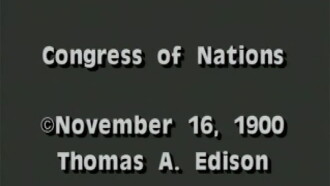
A magician steps upon the stage carrying a hoop covered with white paper. Then in quick succession the flags of Germany, Russia, Ireland, England and China are brought forth, and from each a soldier is produced corresponding with the flag of each nation.
The film is a panorama shot-scene lasting just under a minute. The panorama film, as coined by Lumière, is a moving-camera shot--usually accomplished by placing the camera on a moving transport, such as a boat or train.
This is a new adventure in which our friend, Mr. Hooligan, appears in an entirely new capacity. On a stage a professor of magic is performing some wonderful experiments, and when he requests some assistance Happy Hooligan immediately volunteers his services and climbs upon the platform.
A dramatic scene - and exactly what moving pictures were invented for. With a fixed camera and without a traditional narrative, this film nevertheless tells a compelling story as a cast of men and boys fight an impending crisis.