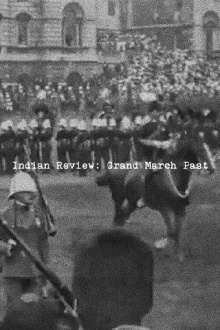
In a crowded London street, sepoys march in full kit. There aren't many details offered for this very short Hepworth picture -- the copy I saw timed in at 20 seconds. The camerawork is ascribed to Cecil Hepworth, and it is certainly possible, even though he had other people working for him at the time. Neither is the event or the exact release date given, but I think it likely it was shot during the celebration of the coronation of King Edward VII.
Watch the official Indian Review: Grand March Past 1902 trailer in HD below.
Watch Full Movies Online
Sorry, we can't find the movie trailer you're looking for.
Either a trailer for this movie has not been released yet, or it
was removed following a request from the copyright holder.
The bicycle was still a novelty at the beginning of the 20th century. At the Villa Belle Rive in Cannes, the Lavanchy-Clarke family engage with it cyclically, with gaps in the film in order to convey a sense of the laps.
"Danse excentrique" (Gaumont #587) is part of the "Miss Lina Esbrard. Danseuse cosmopolite et serpentine" series of 4 films, and should not be confused with "Danse serpentine" (Gaumont #588, the only extant film in the series), "Danse fantaisiste" (Gaumont #589) or "La Gigue" (Gaumont #590).
Georges Méliès adaptation of Robinson Crusoe, the first film adaptation of the story. Filmed in black & white, Méliès would then paint the film by hand to colour it.
First narrative polish film. The janitor sweeps the pavement in front of the tenement house. A carriage comes with a rather solidly inserted young man.
The Washington Star of April 1st, 1900, gave the following account of the ceremony: "Over 40,000 women and children passed through the White House Gates to-day during the hours set apart for the great National show of Egg Rolling, and when the President stepped on the south front gallery at 4:15 P.
"Danse serpentine" (Gaumont #588) is part of the "Miss Lina Esbrard. Danseuse cosmopolite et serpentine" series of 4 films, and should not be confused with "Danse excentrique" (Gaumont #587), "Danse fantaisiste" (Gaumont #589) or "La Gigue" (Gaumont #590).
This film is part of the Mitchell and Kenyon collection - an amazing visual record of everyday life in Britain at the beginning of the twentieth century.