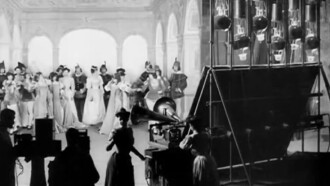
A talented youth has compounded a wonderful fluid, a little of which he applies to the mirror in his room, and when he looks into it his image comes to life and comes out of the frame and imitates his every action. As soon as he rubs the fluid off the mirror his double disappears. When the servant come in, a little of the fluid is again rubbed on the mirror, and he has the same experience, his reflection stepping out and doing stunts, thereby scaring the poor fellow almost to death. The inventor of the fluid then takes the mirror with him and goes out on the street.
Watch the official Wonderful Mirrors 1907 trailer in HD below.
A dying professor leaves his great-nephew a collection of documents pertaining to the Cthulhu Cult. The nephew begins to learn why the study of the cult so fascinated his grandfather.
Charlie plays an actor who bungles several scenes and is kicked out. He returns convincingly dressed as a lady and charms the director, but Charlie never makes it into the film.
A womanizing city man meets Tillie in the country. When he sees that her father has a very large bankroll for his workers, he persuades her to elope with him.
Deep water freediving exposes its practitioners to a form of narcosis, which induces several symptoms, among which a feeling of euphoria and levity that earned this phenomenon its nickname of "raptures of the deep".
A hapless young man living in New York City rallies to save his girlfriend's grandfather's horse-drawn trolley, the last in the city, from being put out of business by a railroad company.
The Tramp interferes with the celebration of several kid auto races in Venice, California (Junior Vanderbilt Cup Race, January 10 and 11, 1914), standing himself in the way of the cameraman who is filming the event.
The hero, a janitor played by Chaplin, is fired from work for accidentally knocking his bucket of water out the window and onto his boss the chief banker (Tandy).
During the Paris Commune, a boy runs across trouble at the barricade. The film is now attributed to Alice Guy-Blaché by the Gaumont company, although there is some debate about whether it was directed by Étienne Arnaud.
A family troupe of acrobats, made up to appear Japanese, perform various unbelievable stunts in front of the camera, achieved through a trick of the camera.