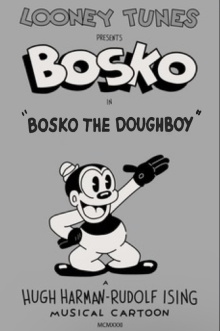
Bosko is a doughboy in the Great War. Bullets and bombs are everywhere. (A bomb even blows up the title card.) Bosko and his fellow infantrymen are hardly safe in their trench. Bosko is happily eating from a pan full of beans when a bomb hits the pan and destroys his meal. Bosko misses Honey; he pulls out her picture and kisses it. A cannonball tears through it, making her head a gaping hole. Now Bosko is angry. He vows revenge but the moment his helmet appears above the trench, it’s hit with dozens of bullets, knocking him back down. Another soldier briefly cheers him up with harmonica music. Bosko gets his chance to be a hero when his buddy swallows a cannonball.
After Acme products fail him one too many times in his dogged pursuit of the Roadrunner, Wile E. Coyote decides to hire a billboard lawyer to sue the Acme Corporation.
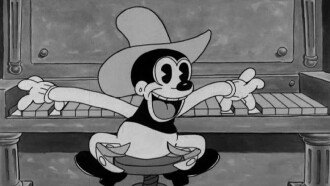
Bosko is a construction worker who impresses Honey by making music from everything in sight, including a decapitated mouse, a typewriter and a goat filled with hot air.
On a tropical island, a native boy sings "Pagan Moon" to his sweetheart. Later, he plays music underwater with an octopus-pianist and other jazz-loving sea life.
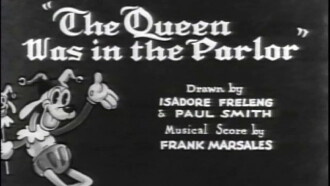
The last Goopy Geer cartoon. The king returns to his castle, and asks where the queen is; she's in the parlor, and won't be seen, according to the title song.
An expectant father rooster fetches doctor stork, who comes out with a basket full of white chicks and one little black one, who gets crowded out of the food.
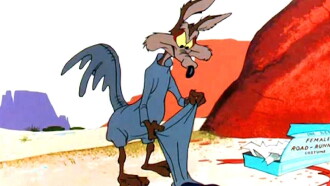
Among the strategies that fail in Wile E. Coyote's attempts to catch the Roadrunner: glue on the road, a giant rubber band, an outboard motor in a wash tub, and dressing in drag as a female Roadrunner.
Alternative movies trailers for Bosko the Doughboy
More movie trailers, teasers, and clips from Bosko the Doughboy:
Looney Tunes Series 15/483: Bosko the Doughboy - 1931 Animated Comedy Film
Looney Tunes Series 15/483: Bosko the Doughboy - 1931 Animated Comedy Film ▻Subscribe ...
Popular movie trailers from 1931
These some of the most viewed trailers for movies released in 1931:
When a criminal named King Fu who has terrorized a city substitutes himself for a stage actor who resembles him, the staff and spectators at that night's show think the actor is giving an unusually good performance.
First of several filmed versions of a popular period operetta, in which an early 18th century noblewoman in Poland falls in love with a revolutionary student activist.
A tale of juvenile delinquency, about a high-school student neglecting his studies, partying hard, falling in with the wrong crowd and finally finding himself on trial for murder committed during a robbery.
The story, about the social interaction of a group of railway passengers who have been stranded at a remote rural station overnight who are increasingly threatened by a latent external force.