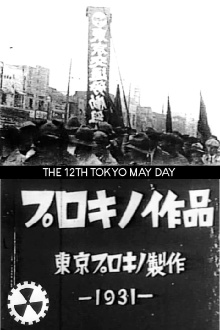
On May 1st, unions all over Japan celebrate May Day, the international day for workers. Workers gather together at parks and hold demonstrations and parades. May Day has its origins in a strike that occurred in the United States on May 1, 1886, a strike that called for an eight-hour workday. Prokino recorded the May Day every year from 1927 to 1932. Among these films, this work is the only one that has survived. However, only its first part has survived. The original film depicts the march to the Ueno Park where the rally was dismissed. Iwasaki Akira coordinated the entire Tokyo Prokino organization as it photographed the 1931 May Day celebrations. They shot in both 16mm and 35mm (other 35mm productions were planned, but this is the only one that achieved completion). A 16mm print was circulated around the countryside by mobile projection units, and a 35mm print was shown at Soviet film nights in Tokyo and Osaka.
A description of the work of a research director of a United Steel Workers Union in Canada. The painstaking research and analyses of economic information, and the arrangement of arguments that lie beneath the negotiations of labour unions for better wages and working conditions are shown.
In july 1936, the civil war began in Spain, and it would last three years. Since then, it has constantly been a subject for fascination and controversy.
A mysterious master criminal known as The Voice plots with his gang to sabotage the Milesburg Oil Company, but the rightful heir has a secret army of her own to protect her rights.
A smart young manicurist works in a hotel where she earns big money by tricking businessmen by persuading them to do certain deals where she has a commission.
Lee is a fresh young kid from the South when he gets a job with The Press. His first assignment on gangsters gets his name in the paper, the police on a raid and Lee in the hospital.
A tale of juvenile delinquency, about a high-school student neglecting his studies, partying hard, falling in with the wrong crowd and finally finding himself on trial for murder committed during a robbery.
First of several filmed versions of a popular period operetta, in which an early 18th century noblewoman in Poland falls in love with a revolutionary student activist.
A tramp falls in love with a beautiful blind flower girl. His on-and-off friendship with a wealthy man allows him to be the girl's benefactor and suitor.
Comments
Have you watched The 12th Tokyo May Day yet? What did you think about it?