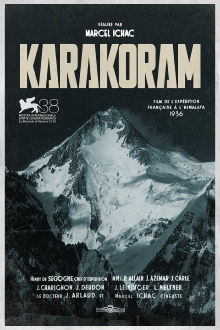
"Film de l'expédition française a l'Himalaya 1936"24 June 1937Adventure, Factual38 mins
Account of the first French expedition to the Himalayas, which attempted to climb the hidden peak (Gasherbrum I) in 1936, from the preparations for the trip to the end of the ascent. After a long approach walk through quasi-desert regions, then on a huge glacier, the caravan of 700 porters arrives at the foot of Hidden Peak. The expedition was led by Henry de Ségogne, with Jean Charignon, Pierre Allain, Raymond Leininger, Jean Carle, Jean Deudon, Louis Neltner, Jacques Azémar, doctor Jeand Arlaud and director Marcel Ichac. Weather conditions, logistical problems and a strike among Sherpas forced the team to retire at 6900m on the south face. The film received the Silver Lion at the Venice Film Festival in 1938.
Using every known means of transportation, several savants from the Geographic Society undertake a journey through the Alps to the Sun which finishes under the sea.
The first part of the film shows parallels between Christianity and Marxism. The second part describes the influence of both the Judeo-Christian background and that of other religious critics on Marx's position as a critic of religion.
An explosion in one of the largest chemical plants in Europe, the Petrochemical complex in Tarragona, triggers the labour struggle of a group of workers who demand what is fair for everyone.
Popular movie trailers from 1937
These some of the most viewed trailers for movies released in 1937:
This is a remake of Columbia's 1932 "Cornered" that starred Tim McCoy. Bob Pearson saves the life of his friend, Sheriff Dick Houston, who has captured two stagecoach bandits and is about to be shot from ambush by a third.
Here is a very rare short film from 1937 called Phony Boy with Cass Daly. There are 3 couples that are dancing Collegiate Shag at the beginning of the short.
The Stooges find a crippled boy and his sister living in their dumpyard shack. To raise money to pay for the little boys operation they buy a phony treasure map from a con man.
Documentary from 1937 filmed in the small Indonesian West Java town of Malabar. Follows the entire process of tea manufacturing from being grown and harvested in the fields, ground and processed in the factory, and eventually shipped out to countries around the world.
Band leader Phil Harris, through a misunderstanding, finds himself with a job as a professional escort, and a date to take a rich young society girl to a night club.
Miss Klutz is the worst dancer that has ever enrolled at the school ran by Maestro Boris Cobblier, and he is even considering giving her money back to get rid of her, a consideration not to his financial liking.