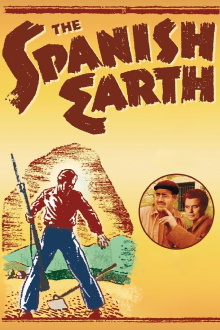
Joris Ivens’s advocacy documentary for the Republican cause intercuts a besieged Madrid with a nearby village digging an irrigation canal, linking the war to bread, land, and survival. Produced by the writers’ collective Contemporary Historians, edited by Helen van Dongen, scored by Marc Blitzstein, and narrated in its U.S. version by Ernest Hemingway (after an initial Orson Welles track), it blends frontline reportage with persuasion against Franco’s forces and their German–Italian backers.
The Spanish journalist Manuel Chaves Nogales (1897-1944) was always there where the news broke out: in the fratricidal Spain of 1936, in Bolshevik Russia, in Fascist Italy, in Nazi Germany, in occupied Paris or in the bombed London of World War II; because his job was to walk, see and tell stories, and thus fight against tyrants, at a time when it was necessary to take sides in order not to be left alone; but he, a man of integrity to the bitter end, never did so.
An audiovisual chronicle of the Spanish Civil War in Galicia. Memorias Rotas centers on a group of republican fighters leaded by Commander José Moreno.
Alternative movies trailers for The Spanish Earth
More movie trailers, teasers, and clips from The Spanish Earth:
The Spanish Earth (1937)
Tells of the struggles during the Spanish Civil War. It deals with the war at different levels: from the political level at the ground military level focusing on battles ...
Ernest Hemingway: The Spanish Earth (1937)
This documentary film uses footage of war and glimpses of rural Spanish life in its portrayal of the struggle of the Spanish Republican government against a ...
The Spanish Earth 1937 Orson Welles and Ernest Hemingway
Ernest Hemingways documentary on Spain during the civil war. Orson Welles got his first job on a commercially-produced film providing the voiceover for it.
The Spanish Earth: Hemingway Ivens and the Spanish Civil War (1937 Poetic Documentary)
A public domain video The Spanish Earth is a 1937 propaganda film made during the Spanish Civil War in support of the democratically elected Republicans ...
The Spanish Earth
1937 Directed by Joris Ivens Commentary by Ernest Hemingway Photography by John Ferno Music by Marc Blitzstein and Virgil Thomson Narrator Orson ...
Tierra de España ( The Spanish Earth ) Voz. E.Hemingway 1/6
1/6 Película documental de Joris Ivens sobre la guerra civil española. Narrada por Ernest Hemingway 1937 Subtítulos en castellano.
Popular movie trailers from 1937
These some of the most viewed trailers for movies released in 1937:
Agent Pete Garland is fired by society singer Monica Barrett after he got her a new radio contract, because she thinks her lawyer friend Teddy Leeds fits in better with her social status.
Dark and windy night, the village is haunted, the villagers do not dare to go out, so they invited the magician to catch the ghost, after a day, the night, the magician was eaten by the ghost, leaving a pile of bones and brains, the villagers buried the bones and brains of the magician.
This travelogue begins at Bangkok's rail depot, a center of Indo-Chinese commerce. Next the narrator talks about Buddhism as the camera shows us some of Bangkok's many temples.