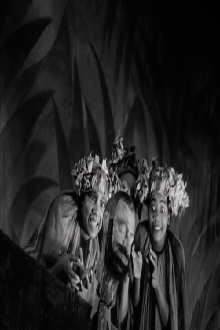
The role of African Americans in the recovery years of the Great Depression is the subject of this informational short, which offers an idealized depiction of life in a segregated society. The highlight, by far, is rare footage of Orson Welles’s “Voodoo Macbeth,” produced in 1935 for the New York Negro Unit of the WPA’s Federal Theatre Project.
Two cats housed in a glass box, one of which had received a small amount of atropine in the preliminary experiment, are exposed to ether vapors with the result that only the animal which had not been pretreated began to salivate (profusely).
Charles Santore, in an expansion of his discussion in “Oz: The American Fairyland” (1997) (V), tells about his experience making an abridged storybook of “The Wizard of Oz”.
Bokanowski returns to the complex - and mind-bending - optical array of pinholes, mirrors, prisms, and refractive substrates of his earlier film, La Plage to create the whimsical and playful Au bord du lac.
Renowned Photographer Chris Floyd captured the tumultuous life of the iconic band The Verve from the inside, as they toured as relative unknowns on their first American tour, all the way through to their farewell tour in 1997 at the very top of their game.
Portrait of the Sunshine Hotel, a flop house on the Bowery in New York's skid row. We meet Vic, the desk clerk, who paints watercolours and pastels; Jonesy, a janitor who talks about bedbugs; Bruce, a voluble alcoholic who makes runs for residents, picking up beer or sandwiches for them and sharing his philosophy with us; Vinnie, on methadone, caring for caged birds; Cashmere, a prostitute, the only woman at the hotel; Earl, who works downstairs in the Bowery's last factory, and Mike, the general manager, who talks about the changing face of the Bowery.
Compulsory locomotion and continuous circular movement to the operated side without orientation in case of a onesided removal of the cerebrum and corpus striatum.
During his adventure in Mexico, Sergei Eisenstein made footage of a Mexican "Death Day" celebration for inclusion in his "Que Viva Mexico!" film project.
More movie trailers, teasers, and clips from We Work Again:
New Deal: We Work Again - 1930's
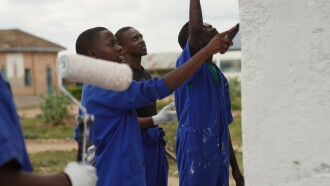
We Work Again is a US government civic-minded film aimed specifically at the unemployed African American population in the wake of the Great Depression.
We Work Again - 1937 WPA Film - Clip 1
A clip from the 1937 Depression-era documentary "We Work Again." Produced by the Works Projects Administration (WPA). Music by Aaron Kenny.
African Americans - WE WORK AGAIN (Reel 1) 1937 Historic HD Footage
True HD Direct Film Transfers - NO UPCONVERSIONS! Series of short or brief images of ...
Newsreel - We Work Again 1937
Newsreel - We Work Again 1937. Public Domain.
Orson Welles' Production of 'Voodoo' Macbeth (From 1936 Documentary Film "We Work Again")
For days Harlem residents strolling anywhere between Lexington Avenue and Broadway from 125th to 140th Streets had seen the word "MACBETH" stenciled ...
Popular movie trailers from 1937
These some of the most viewed trailers for movies released in 1937:
Agent Pete Garland is fired by society singer Monica Barrett after he got her a new radio contract, because she thinks her lawyer friend Teddy Leeds fits in better with her social status.
In this British comedy, set during the Boer War, a foot soldier saves his major's life. The officer is most grateful and puts the soldier in line for a Victoria Cross (a medal for valor).
The Stooges find a crippled boy and his sister living in their dumpyard shack. To raise money to pay for the little boys operation they buy a phony treasure map from a con man.