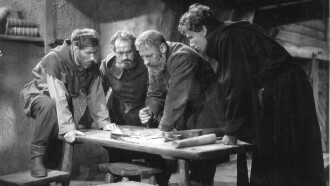
A film based on a poem by Cassiano Ricardo that described the city of São Paulo with its factories, houses, streetcars, lights, life, etc.; a young woman recited the poem while the images showed what she was saying. "Canto da Raça" was never even shown; Getúlio Vargas ordered the censors to seize it on charges of "parochialism." The film was burned; not even the negative survived; everything was burned.
This short starts out as a documentary. In a dramatization, Eadward Muybridge's photographic experiments prove that when a horse gallops, there are times when all four of the animal's feet are off the ground.
A college girl (Bonnie Kildare) dreams of her boyfriend (Johnny Downs) as he sings her a love song. The song begins at graduation ceremony and eventually moves to a soda fountain.
FBI agents Allan Harper and Tommy Baker are in charge of a group of subversives, spies and saboteurs that the US government is deporting to foreign countries aboard a ship.
After Hou Yao moved to Singapore in 1940, he continued to work for the Shaw Brothers under Malay Film Productions and made a handful of films, including Bermadu and Hanchor Hati, before being murdered in 1942.
Switzerland in the 13th century: Shot in the middle of World War II, this classic film returns to the origins of Switzerland and turns about the problem of the small country against a big power: Resist or obey?
Based on a Victor Hugo play, and scored with music from the later opera by Giuseppe Verdi, the film tells about a hunchbacked clown whose beautiful daughter falls in love with the lecherous king.