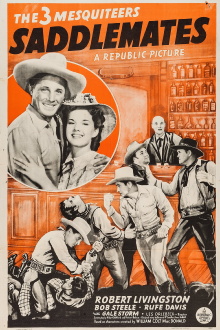
"SAVAGE REDSKINS ON THE WARPATH!"15 May 1941Western56 mins
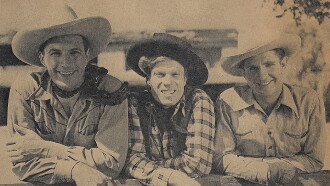
The Three Mesquiteers, as army scouts, soothe hostilities between the Army and Indians after both have been riled by someone with a hidden agenda - a renegade chief, who is found to be masquerading as an Army interpreter.
A horse called Brilliant is the only one who knows the location of a gold mine. When Brilliant's owner is killed, the trio known as the Three Mesquiteers (Bob Steele, Tom Tyler and Jimmie Dodd) are mistakenly arrested for the murder.
The Mesquiteers capture a horse thief who escapes justice through a crooked judge. They gather signatures urging the governor to investigate but a friend with the petition is murdered.
A crooked real estate manipulator sells worthless land on mortgage to flood refugees, then tries to profit by reselling the land to the state, committing murder in the process, as the Three Mesquiteers work to bring him and his gang to justice.
The Cattlemen's Association has called in the Mesquiteers to find cattle rustlers. They get Tex Riley to pose as Stony so Stony can arrive posing as a wanted outlaw.
Popular movie trailers from 1941
These some of the most viewed trailers for movies released in 1941:
Muslims and Crusaders conclude a truce during Richard the Lionheart's illness, and young Arabs seize this opportunity to join their armies in Jerusalem.
Switzerland in the 13th century: Shot in the middle of World War II, this classic film returns to the origins of Switzerland and turns about the problem of the small country against a big power: Resist or obey?
The story of a rich man's son who has just reached the age of adolescence. With his money and good looks, he starts out to conquer the world, especially the feminine world thinking he is the master of everything because of his financial and social standing.
Discovery by Flo Ziegfeld changes a girl's life but not necessarily for the better, as three beautiful women find out when they join the spectacle on Broadway: Susan, the singer who must leave behind her ageing vaudevillian father; vulnerable Sheila, the working girl pursued both by a millionaire and by her loyal boyfriend from Flatbush; and the mysterious European beauty Sandra, whose concert violinist husband cannot endure the thought of their escaping from poverty by promenading her glamor in skimpy costumes.
After Hou Yao moved to Singapore in 1940, he continued to work for the Shaw Brothers under Malay Film Productions and made a handful of films, including Bermadu and Hanchor Hati, before being murdered in 1942.
The title might sound shocking, but the red hands mean, the hands which drag fishnets. Ohama, 15 or 16 years old girl lost her family and lived alone in a fishermen's village.
After losing nearly all of an inheritance to taxes, sisters Kay and Barbara Latimer, waitresses at a drive-in restaurant in Texas, scheme to find rich husbands.
Comments
Have you watched Saddlemates yet? What did you think about it?