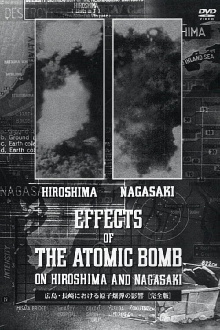
This was the only documentary made in the aftermath of the atomic bombings of 1945. Japanese filmmakers entered the two cities intent on making an appeal to the International Red Cross, but were promptly arrested by newly arriving American troops. The Americans and Japanese eventually worked together to produce this film, a science film unemotionally displaying the effects of atomic particles, blast and fire on everything from concrete to human flesh. No other filmmakers were allowed into the cities, and when the film was done the Americans crated everything up and shipped it to an unknown location. That footage is now lost. However, an American and a Japanese filmmaker each stole and hid a copy of the film, fearful that the reality of Hiroshima and Nagasaki would be hidden from history. Eventually, these prints surfaced and became our only precious archive of the aftermath of nuclear warfare -- a film that everyone knows in part, yet has rarely seen in its entirety.
Assigned to oversee the development of the atomic bomb, Gen. Leslie Groves is a stern military man determined to have the project go according to plan.
Set in German-occupied Norway, resistance fighter Knut Straud enlists the reluctant physicist Rolf Pedersen in an effort to destroy the German heavy water production plant in rural Telemark.
A disturbing collection of 1940s and 1950s United States government-issued propaganda films designed to reassure Americans that the atomic bomb was not a threat to their safety.
Because of a technical defect an American bomber team mistakenly orders the destruction of Moscow. The President of the United States has but little time to prevent an atomic catastrophe from occurring.
Chappy Sinclair is called to gather together a mixed Soviet/U.S. strike force that will perform a surgical strike on a massively defended nuclear missile site in the Middle East.
In 150 years, twice marked by total destruction —a terrible earthquake in 1923 and incendiary bombings in 1945— followed by a spectacular rebirth, Tokyo, the old city of Edo, has become the largest and most futuristic capital in the world in a transformation process fueled by the exceptional resilience of its inhabitants, and nourished by a unique phenomenon of cultural hybridization.
"Trinity and Beyond" is an unsettling yet visually fascinating documentary presenting the history of nuclear weapons development and testing between 1945-1963.
Popular movie trailers from 1946
These some of the most viewed trailers for movies released in 1946:
Childhood sweethearts from opposing social standings are separated when one's family moves elsewhere, leaving behind only a watch as a token of their friendship.
At the Polar Bar & Grill in the Klondike, Popeye and Olive Oyl are the sole proprietors. Dangerous Dan McBluto, the owner of a fur farm, walks in and kidnaps Olive.
Madrid, late 19th century. A wealthy woman is found murdered in her home and her maid seems to be the main suspect; but her statement further entangles the case.
An evil Czarist landowner had mistreated the father and friends of an officer.The officer wreaks vengeance by committing masked coach robberies and insinuates himself into his enemy's castle by pretending to be a French teacher.
Veteran cowboy star Johnny Mack Brown plays a cattle buyer turned prairie sleuth in this low-budget oater from Monogram, which co-stars perennial old-timer Raymond Hatton as a retired U.
Comments
Have you watched Effects of the Atomic Bomb on Hiroshima and Nagasaki yet? What did you think about it?