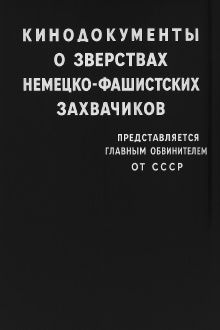
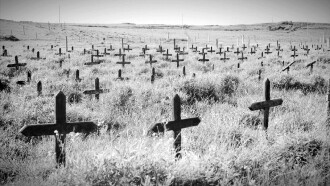
This Soviet-made film was screened on February 19, 1946 on the 62nd day of the Nuremberg Trial and submitted as evidence relevant to the indictment for "crimes against humanity." The one-hour film with voiceover commentary shows visual evidence of the extermination camps of Auschwitz and Majdanek and appeals to spectators' emotions by emphasizing individual victims. The central argument of the film is that the Germans were the executioners of peaceful Soviet citizens. At the time, it made a very strong impression on both the accused and press. The film is a re-edited compilation of footage collected by the Soviet film team over four years (primarily used for propagandistic ends in wartime Soviet newsreels and documentaries). It was prepared in emergency by the Soviet prosecution team and minister of cinema following the projection of Nazi Concentration Camps presented by the Americans on November 29, 1945.
On Dec. 5, 1944, American soldiers, led by Harry Stuts, put their guns down for one day and organized a party celebrating the town's centuries-old Saint Nick tradition.
British intelligence undertook an audacious operation to listen in on the private conversations of 10,000 German prisoners of war without their ever knowing they were being overheard.
Engineer Dr Hugh Hunt revisits the little-known story of the First World War's Blitz, when the Zeppelin waged an 18-month terror campaign on the people of London.
Churchill, a name typically associated with braveness and altruism. Recently found evidence from Soviet and British sources however brings up questions about Churchill's doings in the conferences of Tehran, Yalta and Potsdam.
Caroline Sturdy Colls, a world leader in the forensic investigation of Nazi crime scenes, is chasing clues to an unsolved case: a concentration camp that existed on the British island of Alderney.
Created in the Victorian era to widen the mouth of the River Tees for shipping, South Gare is a man-made peninsula extending four kilometres into the cold North Sea.
Is American foreign policy dominated by the idea of military supremacy? Has the military become too important in American life? Jarecki's shrewd and intelligent polemic would seem to give an affirmative answer to each of these questions.
Popular movie trailers from 1946
These some of the most viewed trailers for movies released in 1946:
In order to help bring Nazis to justice, U.S. government agent T.R. Devlin recruits Alicia Huberman, the American daughter of a convicted German war criminal, as a spy.
The proprietor of an ice-skating revue promotes a peanut-vendor to a management position based on suggestions he made to improve the act of the show's star, who also happens to be the owner's wife.
Lulu goes to a department store to exchange her doll for something else. While looking for a new item Lulu manages to terrorize the section manager, ski down the escalators, and cause a noahic flood in the store.
All-American singing cowboy Jimmy Wakely went below the border in this musical Western from the assembly line at Monogram, performing such ditties as Adios Mariquita Linda, Rose of the Rancho, the inevitable La Cucaracha, and his own title tune.
Andy Panda is very fond of apples and he eats a bushel of green apples, falls asleep and has a nightmare in which the devil is trying to entice him into Hades and stuffs him full of apple juice, applesauce and more apples.
The cattle herds of some Arizona ranchers are being stampeded and stolen, so the Arizona Stockmen's Syndicate sends ace investigator Steve Reynolds in to find out who is responsible.
In 1834, Charles Stewart (Alan Ladd), the spoiled, dissolute son of a shipping magnate, is shanghaied aboard the Pilgrim, one of his father's own ships.
A tale of an international counterfeiting-ring operating in Mexico starts with Patrick Nevil viewed as a suspicious character by newspaper woman Agnes Stuart, who is working on a story to expose racketeering night-club owner Doc Lilley.
Comments
Have you watched Film Documents of the Atrocities of the German Fascist Invaders yet? What did you think about it?