The Teachers’ Crisis (MARCH OF TIME) puts the pointer on one of the biggest U.S. problems—education. By narrative, charts and acted episodes, the film dramatizes the fact that, with public school enrollments bigger than ever before, and constantly growing, the U.S. has fewer public-school teachers than it had in 1939. Of these teachers many are pitifully ill-trained “emergency” amateurs. (The film shows the too common spectacle of a teacher unable to work a problem she has given students.) Still others are psychologically unfit to teach (the film shows a stupid teacher calling a pupil stupid).
In this short directed by Pietro Francisci, later known for hit swords-and-sandals titles such as 1958’s “Hercules” starring Steve Reeves, Lollobrigida appears to sing (she may have been dubbed) Italian folk song “Stornellata Romana.
A young bullfighter full of illusions triumphs in Mexico and decides to get married there and forget about his old Spanish girlfriend, who by then has just given birth to his son.
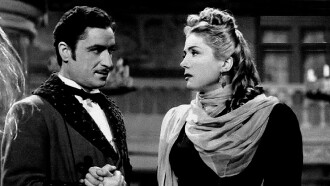
Paris, 1857. While on trial for moral outrage, French writer G. Flaubert tells the court and the audience the true story of the heroine of his novel Madame Bovary, a sensitive but capricious woman whose desperate efforts to overcome the bourgeois conventions of a dull, provincial life led her family first to ruin and disrepute and finally to the abyss of tragedy.
A hated country gentleman is murdered, and the inspector on the case takes the veiwer through his thoughts about the possible murderer and motives as he questions everyone concerned.
The third of the Monogram series based on Ham Fisher's "Joe Palooka" comic strip, opens with Knobby Walsh, the manager of Joe Palooka trying to talk his way out of a traffic citation, and the story leading to that point is told in flashback as narrated by Walsh.
A virtuous Spanish princess becomes queen of Portugal, and soon is affected by the social struggles and the reckless fight to power between the king's faction and that of his son's.