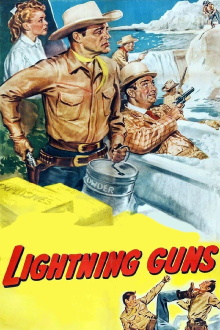
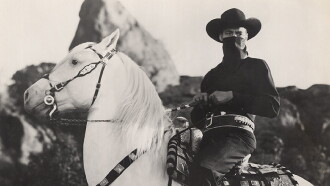
The Durango Kid rides again in Lightning Guns. As ever, the masked Durango (alias Steve Brandon) is played by Charles Starrett, who this time around is on the trail of a gang of cold-blooded killers. Rancher Dan Saunders (Edgar Dearing) is held responsible for the killings because of his opposition to a politically expedient dam project. Durango believes that Saunders is innocent, and he intends to prove it.
Federal agent Steve Lawton works undercover with his assistant, Smiley Burnette, to track down an outlaw gang that is raiding government gold shipments bound for Fort Navajo.
Filmed at the Providencia Ranch (today's Forrest Lawn in Burbank, CA), this typical "Durango Kid" Western featured the Cass County Boys performing "Go West Young Lady" by Sammy Cahn and Saul Chaplin, in addition to series regular Smiley Burnette singing his own "It's My Turn" and "The Yodeler.
It's 1873 and the disbanded Texas Rangers have been replaced by the corrupt Texas State Police. Steve Lanning arrives posing as a wanted outlaw to get in with them in his attempt to have them replaced.
Charles Starrett returns as the Durango Kid in Columbia's Rough, Tough, West. For most of the film, however, Starrett is known as "Steve Holden," a former Texas Ranger who comes to a wide-open mining town to visit an old friend (Jack -- later Jock -- Mahoney).
Charles Starrett makes his final appearance as The Durango Kid, this time as Steve Reynolds, a postal inspector who has gone underground to catch the bad guys.
Starrett tries to prevent a range war between settlers and the Native Americans. Blue and his fellow scoundrels think they can profit from the bloodshed,but the Durango Kid along with a couple of precocious youngsters put an end to Blue's terrorism.
Popular movie trailers from 1950
These some of the most viewed trailers for movies released in 1950:
Notorious stagecoach robber Rhiannon is unintentionally appointed as deputy when he saves the sheriff's life and must wear two hats between his new job that he enjoys and his old occupation that he misses.
Arizona Ranger Larry Grant is posing as an outlaw while hunting for an outlaw gang, secretly led by Lance Corbin, that is stealing silver in Mexico and smelting it into bars for sale in the United States.
In Milan, the beggar Carlone has formed a brotherhood. Carlone's sister Anna, is a poor blind girl. One day Carlone saves a mutilated, who tried to end his days.
This Traveltalk series short takes us to Edinburgh, Scotland. We learn the importance of religion, science and the arts here and see various historic sites including Edinburgh Castle.
Cinderella has faith her dreams of a better life will come true. With help from her loyal mice friends and a wave of her Fairy Godmother's wand, Cinderella's rags are magically turned into a glorious gown and off she goes to the Royal Ball.
A young rogue kills an old lady to rob her. Arrested, he believes it is for this crime, hides nothing from his lawyer, who soon tells him that he is only accused of another theft prior to his crime.