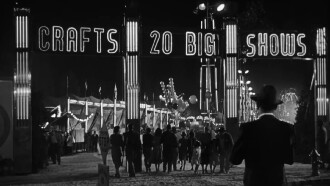
Robert Ménégoz’s film depicting the struggles of French dockworkers in the winter and early spring of 1950 is meant to evoke the feelings of insecurity, exertion and danger of this profession whose rights were not sufficiently reflected in post-war France. At the same time, the heroic image of dockworkers is meant to mobilize against American policy, the Marshall Plan, German rearmament and the war in Indochina. Banned by the censors in France, the film won the Grand Prix for Documentary at the 1951 Karlovy Vary Film Festival.
"My mother is Japanese, a drifting diva of Tokyo" After the death of her father Reika goes to Japan to visit her mother, but can't find her, so she starts performing at a cabaret in Yokohama.
Five-year-old Patsy has competition for her father's attention from the family's new baby. Her attempts to win her father's praise receive instead a rebuke.
Fong Yim-fun puts on a tour de force as an ill-fated woman, separated from her lover through an arranged marriage to the terminally ill and impotent son of a warlord.
A beany-capped, wise-cracking crow invades a corn field owned by an elderly farmer. The farmer unsuccessfully attempts to kill the crow by using a gun, an axe, and a cannon.
Two men search the jungle for a woman who has been captured by a tribe of murderous gorillas. When they finally find her, they must fight off attacks by the gorillas, who are determined to keep her.
Bored with her bourgeois life, the young Maria Variani, daughter of a professor, meets Bruno, who is part of an amateur jazz group, and allows herself to be persuaded to join the band that plays during the radio program "The microphone is yours".