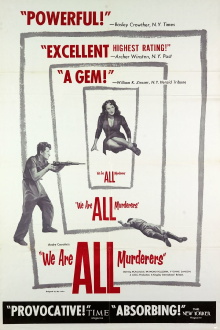
Originally titled Nous Sommes Tout des Assassins, We Are All Murderers was directed by Andre Cayette, a former lawyer who detested France's execution system. Charles Spaak's screenplay makes no attempt to launder the four principal characters (Marcel Mouloudji, Raymond Pellegrin, Antoinine Balpetre, Julien Verdeir): never mind the motivations, these are all hardened murderers. Still, the film condemns the sadistic ritual through which these four men are brought to the guillotine. In France, the policy is to never tell the condemned man when the execution will occur--and then to show up without warning and drag the victim kicking and screaming to his doom, without any opportunity to make peace with himself or his Maker. By the end of this harrowing film, the audience feels as dehumanized as the four "protagonists." We Are All Murderers was roundly roasted by the French law enforcement establishment, but it won a special jury prize at the 1952 Cannes Film Festival.
The defense and the prosecution have rested and the jury is filing into the jury room to decide if a young Spanish-American is guilty or innocent of murdering his father.
Miserable critic, Brian Tanner, is famous for his vicious film reviews on his TV show Critical Eye. Over the years, he's grown to hate pretty much everything he sees, including his wife.
Following in his father's footsteps, Albert Pierrepoint becomes one of Britain's most prolific executioners, hiding his identity as a grocery deliveryman.
A newspaper publisher, wanting to prove a point about the insufficiency of circumstantial evidence, talks his possible son-in-law Tom into a hoax in an attempt to expose ineptitude of the city's hard-line district attorney.
An LA police officer is murdered in the onion fields outside of Bakersfield. However, legal loopholes could keep his kidnappers from receiving justice, and his partner is haunted by overwhelming survivor's guilt.
We do not know when and how we will die. Death Row inmates do. Werner Herzog embarks on a dialogue with Death Row inmates, asks questions about life and death and looks deep into these individuals, their stories, their crimes.
Popular movie trailers from 1952
These some of the most viewed trailers for movies released in 1952:
Wacky rich woman subjects her husband, servants and friends to a series of elaborate masquerades, remodeling her house and wardrobe every couple of days to represent different historical eras or cultural milieux.
In 1927 Hollywood, a silent film star falls for a chorus girl just as he and his paranoid screen partner struggle to make the difficult transition to talking pictures.
"She Came Like a Wind" - Fabian Rosander works at a factory and is close to 50 years old. When a new employee named Lilly, a young beautiful girl, comes to the factory Fabians life takes a new turn.
Comments
Have you watched We Are All Murderers yet? What did you think about it?