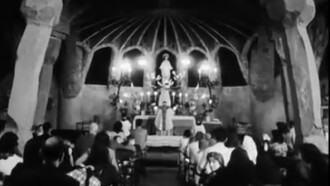
At the time this film was made, motion picture theaters were required to pay a 20% tax on gross ticket sales, and Congress was debating lowering this tax (as well as others) in a bill being considered by a Congressional committee. This film, which was made especially to be shown to members of the committee, sets forth the motion picture industry's case for reducing, if not eliminating, the tax.
The Chaperone tells the true, previously untold story of a lone school teacher who fought off an entire motorcycle gang while chaperoning a middle school dance in a church basement in 1970s Montreal, Canada.
Birthright, which presents the work of the Family Planning Association, is a valuable record of the organisation of contraception and fertility services before the introduction of the contraceptive pill.
Photomicrography reveals the unusual structure and behavior of the Venus's flytrap, the trumpet plant, the cobra plant, the common pitcher plant, the sundew plant and the utricularia.
Based on Eimear Ryan’s essay ‘The Fear of Winning’, three successful female athletes explore how being physically courageous, unapologetically competitive and deeply passionate in team sport can unlock a freedom to really occupy your own skin.
Car parts found at a garbage dump, old mannequins, clocks and bicycle racks find a new purpose as installations in an exhibition.
Alternative movies trailers for The Case Against the 20% Federal Admissions Tax on Motion Picture Theatres
More movie trailers, teasers, and clips from The Case Against the 20% Federal Admissions Tax on Motion Picture Theatres:
The Case Against the 20% Federal Admissions Tax on Motion Picture Theatres
The motion picture industry created this short film in 1953 to present their view on the 20% Federal Admissions Tax on theatre receipts in front of Congress.
Popular movie trailers from 1953
These some of the most viewed trailers for movies released in 1953:
Swindler in jail devises a scheme to blackmail the family of recently deceased people, threatening to tell supposedly incriminating facts about their dead relatives' lives.
Inspan is dedicated to tough pioneers, who along dangerous roads - with courage and strength - developed the vital transport routes for a young and growing country - the transport riders.
The new steward of Siltala ends up falling in love with the beautiful widow of the house. Their romance is endangered by misunderstandings and the fact that the estate of Siltala is swimming in debt.
In 16th century Japan, peasants Genjuro and Tobei sell their earthenware pots to a group of soldiers in a nearby village, in defiance of a local sage's warning against seeking to profit from warfare.