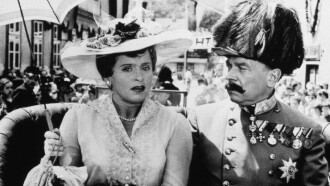
The signing of the State Treaty on 15. May 1955 was the reason for an elaborate special report of the AUSTRIA WOCHENSCHAU. The color-shot film report documents the arrival of the foreign ministers of the four signatory powers of the Soviet Union, the USA, Great Britain and France. This is followed by the iconic recordings with the signing of the Austrian State Treaty and the proclamation of Leopold Figl: »Austria is free!«. Also visible is the dissolution of the Allied Council with the last military parade on 27. July 1955 and the withdrawal of the occupying powers. This special edition of the AUSTRIA WOCHENSCHAU came on 28. October 1955 in Austrian cinemas.
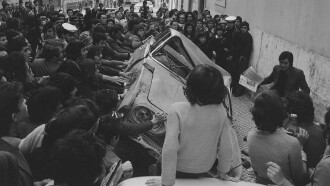
In Portugal, during the night of April 24-25, 1974, a peaceful uprising put an end to the last government of the Estado Novo, the authoritarian regime established in 1933 by dictator António de Oliveira Salazar (1889-1970), paving the way for full democracy: a chronicle of the Carnation Revolution.
The life and work of German political philosopher of Jewish descent Hannah Arendt (1906-75), who caused a stir when she coined a subversive concept, the banality of evil, in her 1963 book on the trial of Nazi war criminal Adolph Eichmann (1906-62), held in Israel in 1961, which she covered for the New Yorker magazine.
The incredible life of Jorge Semprún (1923-2011): son of a republican intellectual; exiled in the early days of the Spanish Civil War; survivor of the Buchenwald concentration camp during World War II; clandestine communist in Spain during Franco's dictatorship; controversial socialist politician; acclaimed writer, screenwriter and filmmaker.
Gdańsk, Poland, September 1980. Lech Wałęsa and other Lenin shipyard workers found Solidarność (Solidarity), the first independent trade union behind the Iron Curtain.
Six million Jews died during World War II, both in the extermination camps and murdered by the mobile commandos of the Einsatzgruppen and police battalions, whose members shot men, women and children, day after day, obediently, as if it were a normal job, a fact that is hardly known today.
A new reading of the historical period that began with the reign of the Catholic Monarchs (1479-1516) and the discovery of America (1492), as well as an analysis of its undeniable influence on the subsequent evolution of the history of Spain and the world.
In April 1918, a disease of unknown origin swept across the five continents. In 18 months, millions of lives that had not been taken by the war were swept away by a virus that would cause the worst pandemic in history: the Spanish flu.
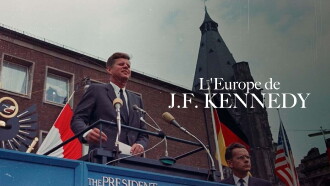
A docudrama on John F. Kennedy's early travels through Europe with his best friend Lem Billings. A road trip that would lay the foundation for JFK's later love for Europe and its countries, such as Germany.
St. Petersburg, Russia, December 30th, 1916. Grigori Rasputin is assassinated. The story of the humble peasant who became the most influential adviser to czarina Alexandra Feodorovna, wife of the last czar, Nicholas II Romanov.
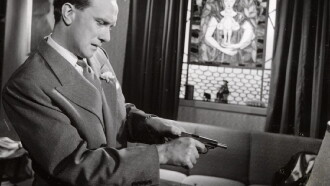
Ghosts and premonitions; a married woman discovers the true love of her life while being plagued with supernatural phenomena relating to her imminent murder.
While her new husband is away looking for work, the wife loses the child she was expecting and uses another woman's baby as a substitute so she won't have to upset her spouse when he returns.
A woman impressed by news reports about flying saucers, gets hit on the head by a vase, passes out and dreams that she is the 'Queen of Mars', from where she sends an expedition to Earth in order to bring back Rio's Carnaval to the planet.
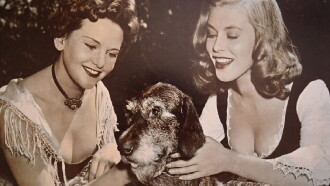
Somewhere in the Salzburg mountains, young poacher Hans tries to conquer the heart of pretty schoolteacher Helga but is overthrown by forest warden Thomas.
Comments
Have you watched Austria Is Free yet? What did you think about it?