The story of Viktor Stratoberdha (1921-1991) mirrors many of Albania’s tragedies. Stradoberdha’s humorous, buoyant style led him to be one of the country’s most promising filmmakers. But after being denounced in 1956, he was expelled from the Kinostudio and sent into internal exile. In 1967, Stratoberdha directed a local theater play in which the economic five year plan was placed in a coffin. He was then jailed for the next two decades. Urime Shokë Studentë! is one of the surviving documentaries of Viktor Stratoberdha’s all too short career.
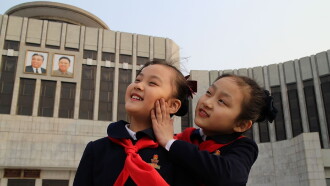
Over the course of one year, this film follows the life of an ordinary Pyongyang family whose daughter was chosen to take part in Day of the Shining Star (Kim Jong-il's birthday) celebration.
A disturbing collection of 1940s and 1950s United States government-issued propaganda films designed to reassure Americans that the atomic bomb was not a threat to their safety.
This propaganda film was supported by US Information Service (USIS) and presents Bangkok as a peaceful and developing city at the centre of the “free world,” a narrative pushed forth to counter the threat of the Cold War.
A relentless chronicle of the tragedy of the Uighurs, an ethnic minority of some eleven million people who live in the Xinjiang region of northwest China, speak a Turkic language and practice the Muslim religion.
High Tor is a 1936 play by Maxwell Anderson. Twenty years after the original production, Anderson adapted it into a television musical with Arthur Schwartz.
Starship C57D travels to planet Altair 4 in search of the crew of spaceship "Bellerophon," a scientific expedition that has been missing for twenty years.
The film is based on two couples – where the first couple Dr. Chandra Shekar (Gemini Ganesan) & Parvathi (Anjali Devi) and the second couple is Ravi (A.
Comments
Have you watched Congratulations, Comrade Student! yet? What did you think about it?