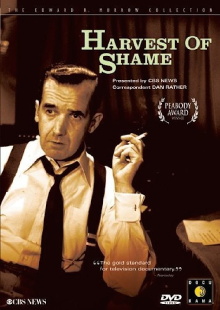
In this CBS News production broadcast on Thanksgiving 1960, Edward R. Murrow points out the plight of migrant farm workers in America. Topics range from the harsh living conditions, endless travel, low wages, and poor opportunities for their children.
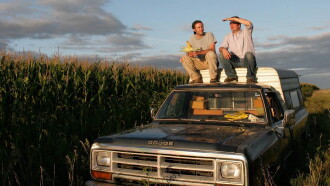
King Corn is a fun and crusading journey into the digestive tract of our fast food nation where one ultra-industrial, pesticide-laden, heavily-subsidized commodity dominates the food pyramid from top to bottom – corn.
Documentary filmmaker Robert Kenner examines how mammoth corporations have taken over all aspects of the food chain in the United States, from the farms where our food is grown to the chain restaurants and supermarkets where it's sold.
In California’s Central Valley, tucked between the county jail and the shooting range, 100 Mexican-American farmworking families live, love and strive at the Artesi II Migrant Family Housing Center.
Local, organic, and sustainable are words we associate with food production today, but 40 years ago, when Fran and Tony McQuail started farming in Southwestern Ontario, they were barely spoken.
In 1980, Jack Shae and Allen Moore, two ethnographic filmmakers from Harvard University, moved their families to the island of Berneray in the Outer Hebrides.
In search of a more sustainable food system, three organic farming pioneers discuss their hopes and doubts with a spectrum of experts and stakeholders.
A picture promoting collective farming and the use of tractors in agriculture. It introduces the work of the state tractor station in Chlumec - from the development of a uniform deployment plan to the departure of tractor drivers for specified tasks.
Though a piece of meat figures in this film the real subject is, before you judge something not just a steak, think twice, as for instance the way two people in a situation present themselves to each other.
Seoul, under a drizzling spring rain; Korea is under the rule of Japan. A gisaeng(Korean geisha) named Jeong-ok (Ju Jeung-nyeo) and Myeong-gyu (Lee Min), the son of a bank president, fall in love.
When larcenous real estate clerk Marion Crane goes on the lam with a wad of cash and hopes of starting a new life, she ends up at the notorious Bates Motel, where manager Norman Bates cares for his housebound mother.
In the northern part of the Atlantic Ocean on the island of Troldø lives a single farming family. The grandmother Gunhild is the only woman on the island and her son Enok is unable to find a wife.
Newly graduated defense attorney David Kyle (Vincent Ball) is stymied by his first case: to represent youthful criminal Jimmy Fuller (Brian Smith), who refuses to explain his involvement in the murder of the revered Diana White (Angela Douglas), a probation officer seemingly devoted to her work.
In 1913 a family of traveling musicians goes to the house of a rich marquise. Lolita, daughter of one of the musicians, encounters the son of the wealthy lady.
Comments
Have you watched CBS Reports: Harvest of Shame yet? What did you think about it?