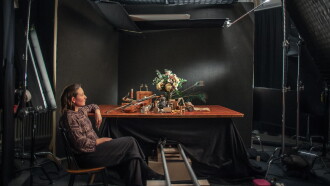
A film made for the 25th anniversary of the Fram Museum. The museum is home to the ship Fram, which was used by Roald Amundsen, Fridtjof Nansen, and Otto Sverdrup on their legendary polar expeditions. // Oslofilm was a series of public information films about life in and around Oslo, produced between 1940 and 1980. Funded by the state, the films offer valuable insight into postwar Norwegian society. A wide range of Norwegian filmmakers contributed to the productions, resulting in a rich variety of styles and expressions. Several of the films also possess notable cinematic qualities, standing out as more than just informational material. The Oslofilms represent a unique and important chapter in Norwegian film history.
Although first glance reveals little more than stones and sand, the desert is alive. Witness moving rocks, spitting mud pots, gorgeous flowers and the never-ending battle for survival between desert creatures of every shape, size and description.
Since the late 18th century American legal decision that the business corporation organizational model is legally a person, it has become a dominant economic, political and social force around the globe.
After 52 years of armed conflict the FARC guerrillas are about to hand over their arms in exchange for political participation and social inclusion of the poor.
For the family members of murder victims mourning is often postponed indefinitely. To unlock the trauma and begin the grieving, a method called restorative dialogue brings two parents - and the audience - eye to eye with the murderers.
A documentary which follows director Wim Wenders and Sean Naughton, the high-definition-video designer on UNTIL THE END OF THE WORLD, in Tokyo, and details the creation of the film’s groundbreaking high-definition sequences.
Sirkka-Liisa died alone with no one left to miss her. Elina happened to buy her home after her death and ended up with all Sirkka-Liisa's possessions from books to photos.
At a weekend gathering, a man tells a woman that they had spent time there together a year prior. But, the woman has no recollection whatsoever and is convinced that he is simply fabricating the encounter.
Munich cab driver Herbert Sponer picks up American businessman Jack Mortimer at the train station. Suddenly Mortimer is shot while driving and Sponer has to try to avoid being suspected as the perpetrator.
Two identical twin sisters, separated at birth by their parents' divorce, are reunited years later at a summer camp, where they scheme to bring their parents back together.
In Manhattan’s Upper West Side, rival gangs of Polish-Americans and newly arrived Puerto Ricans clash for control of the neighborhood, even as two young members from opposite sides fall dangerously in love.
A team of allied saboteurs are assigned an impossible mission: infiltrate an impregnable Nazi-held island and destroy the two enormous long-range field guns that prevent the rescue of 2,000 trapped British soldiers.