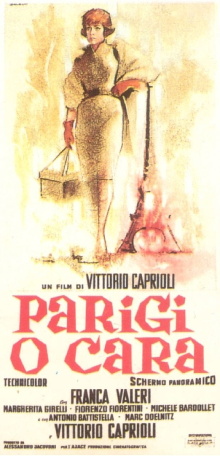
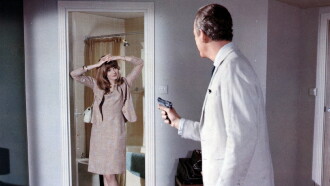
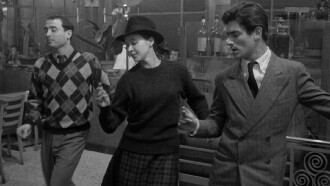
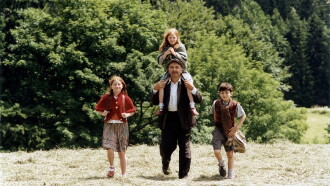
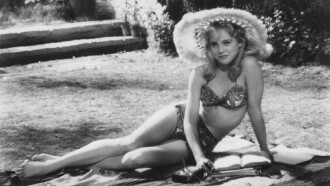
Parigi O Cara is probably the most camp in the history of Italian cinema, certainly a favourite with the queer community who quote its lines by heart. Unique as it's the only film where Franca Valeri (now 90) is the unquestioned star, in the role of Delia, a snobbish, stingy prostitute who is moving to Paris looking for greener and more lucrative pastures. An anti-neorealist, amoral, almost abstract comedy, which anticipates Almodóvar, a ferocious, though gentle, non-moralistic portrayal of the 60's boom and its broken dreams. The dialogue between Delia and her brother (played by Fiorenzo Fiorentini), when he does (or does not) tell her he is a homosexual, is memorable, a primordial coming-out, a masterpiece of allusions. But what makes it one of the first examples of a film with a "gay point of view" is the approach: perceptive, non-conformist, caustically witty. A film ahead of its times, still unbeaten.
A young woman from the Midwest gets more than she bargained for when she moves to New York to become a writer and ends up as the assistant to the tyrannical, larger-than-life editor-in-chief of a major fashion magazine.
During World War II, two French civilians and a downed British Bomber Crew set out from Paris to cross the demarcation line between Nazi-occupied Northern France and the South.
After her fiancee admits to infidelity while on a business trip in France, a woman attempts to get her lover back and marry him by traveling to Paris despite her crippling fear of flying.
After Regina Lampert falls for the dashing Peter Joshua on a skiing holiday in the French Alps, she discovers upon her return to Paris that her husband has been murdered.
A local doctor is recruited as a cold war spy to fulfill a very important secret mission in the Middle East, only to experience that his mission is complicated by a sexy female double agent.
On an otherwise normal day, Étienne, a happily married man and a good father, sees something that stops him dead in his tracks: a gorgeous woman in a billowing red dress.
In 1942, in an occupied Paris, the apolitical grocer Edmond Batignole lives with his wife and daughter in a small apartment in the building of his grocery.
Popular movie trailers from 1962
These some of the most viewed trailers for movies released in 1962:
Brigadier General Frank D. Merrill leads the 3,000 American volunteers of his 5307th Composite Unit (Provisional), aka "Merrill's Marauders", behind Japanese lines across Burma to Myitkyina, pushing beyond their limits and fighting pitched battles at every strong-point.
Raja, the son of a rich man who was cheated of his wealth by Jambu, grows up in an orphanage. He becomes a famous poet in the city with the help of Jambu's family, unaware of his past.
When a worker digging up a rose bed in the garden of a rich, influential factory owner uncovers a skeleton, suspicion spreads: Is the man who is so respected in the town possibly a murderer?