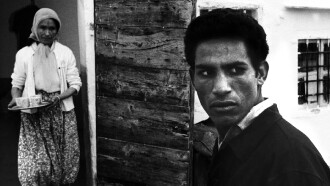
This story, set against the backdrop of the Algerian War, could be an oriental tale. The "Nightingale of Kabylia" is the nickname given to old Ahieddine, a poet who lives in a mountain village. Ahieddine receives a visit from a young French officer. What does the officer want? Information, no doubt. The lieutenant, who once studied the Kabyle language, simply wants to visit a renowned poet, speak with him, and hear him recite a poem. Such a visit will be difficult to justify to the men of the maquis. That very evening, Ahieddine is summoned to appear before a tribunal of maquisards. He is condemned to death for treason. Does he have a wish before he dies? Yes, to compose one last poem, the poem of his death. He improvises a poem; the men listen, moved by the words of their own language, which express the poetry of their people. They pardon old Ahieddine and grant him his freedom. Destiny, however, awaited at the bend of a mountain path, the "Nightingale of Kabylia".
In 1960, nine-year-old Bachir dreamed of becoming the son of a martyr because he had heard that the children of martyrs would obtain everything after independence.
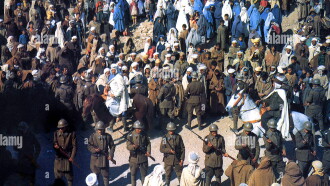
Former petty criminal Ali la Pointe becomes a commander of the Algerian Front de Liberation Nationale, directing a guerilla insurgency against the colonial French occupation.
Agnès Varda eloquently captures Paris in the sixties with this real-time portrait of a singer set adrift in the city as she awaits test results of a biopsy.
Despite his lack of political convictions, photojournalist Bruno Forestier is roped into a paramilitary group waging a shadow war in Geneva against the Algerian independence movement.
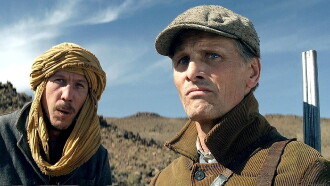
A French teacher in a small Algerian village during the Algerian War forms an unexpected bond with a dissident who is ordered to be turned in to the authorities.
Parisian authorities clash with the Front de Libération Nationale (FLN) in director Alain Tasma’s recounting of one of the darkest moments of the Algerian War of Independence.
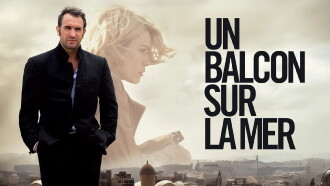
Happily married with a daughter, Marc is a successful real estate agent in Aix-en-Provence. One day, he has an appointment with a woman to view a traditional country house.
A meticulous chronicle of the evolution of the Algerian national movement from 1939 until the outbreak of the revolution on November 1, 1954, the film unequivocally demonstrates that the "Algerian War" is not an accident of history, but a slow process of suffering and warlike revolts, uninterrupted, from the start of colonization in 1830, until this "Red All Saints' Day" of November 1, 1954.
Popular movie trailers from 1962
These some of the most viewed trailers for movies released in 1962:
When a worker digging up a rose bed in the garden of a rich, influential factory owner uncovers a skeleton, suspicion spreads: Is the man who is so respected in the town possibly a murderer?
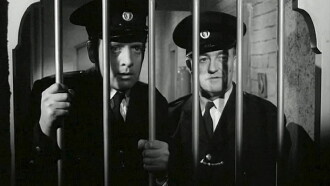
Thomas Crimmins is a new warder, or guard, in an Irish prison. He is young, naive, and idealistic, determined to serve his country by his part in meting out justice to criminals.
A group of boys playing near the seashore in Tokyo find a goat, kill it in a tug of war for ownership, bury it with ceremony, and, except for one boy, run off in heedless laughter ready for more games.
Five short stories.
(1) “Czas przybliża, czas oddala” – Edward recalls his unfulfilled love for Anna and, years later, writes to her sister Zofia, mistaking her for Anna.
Raja, the son of a rich man who was cheated of his wealth by Jambu, grows up in an orphanage. He becomes a famous poet in the city with the help of Jambu's family, unaware of his past.
In 1911, Arnolphe Combalette left his corner of Provence to seek his fortune in the Americas. Fifty years later, a letter from him arrived in the village: "No, I'm not dead yet, but it won't be long now.