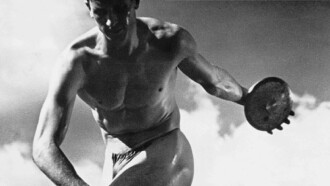
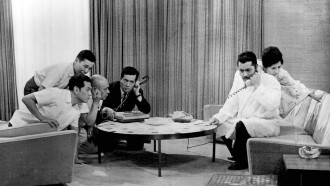
A documentary film that includes footage of past Olympics held in different countries with an particular emphasis on the activities and successes of Japanese athletes and how they are currently (circa 1963) improving themselves.
Caitlyn Jenner's unlikely path to Olympic glory was inspirational. But her more challenging road to embracing her true self proved even more meaningful.
At the Winter Olympics of 1980, after two tense weeks amidst growing Cold War fears, the U.S. Olympic hockey team found themselves playing improbably against the legendary unbeatable Soviet Army hockey team for Olympic Gold.
Starting with a long and lyrical overture, evoking the origins of the Olympic Games in ancient Greece, Riefenstahl covers twenty-one athletic events in the first half of this two-part love letter to the human body and spirit, culminating with the marathon, where Jesse Owens became the first track and field athlete to win four gold medals in a single Olympics.
Part two of Leni Riefenstahl's monumental examination of the 1938 Olympic Games, the cameras leave the main stadium and venture into the many halls and fields deployed for such sports as fencing, polo, cycling, and the modern pentathlon, which was won by American Glenn Morris.
This film is about Japanese women, escape, glamour and dreams. The Takarazuka Revue is an enormously successful spectacular where the all-women cast create fantasies of erotic love and sensitive men.
Popular movie trailers from 1963
These some of the most viewed trailers for movies released in 1963:
Returning from Switzerland, a young investigator meets María, his father's new wife. They immediately feel an irresistible attraction, which he tries to overcome by mixing it up with another woman.
João Eduardo, a young inexperienced doctor, takes up work in a village. The initial skepticism from the community gives place to esteem for the new physician after some well succeeded cases.
Cesar Borgia--a cardinal in the Catholic church, a confidant of the Pope and a member of one of the wealthiest and most powerful families in 16th-century Italy--must deal with a host of political and personal crises.
Because factory owner's son and womanizer Karl Fischer is constantly avoiding his rich fiancée Almut, his father Waldemar sends the flighty little boy to Italy, where he is supposed to work in his future father-in-law's business and come to his senses.
Tired of the constant abuse he suffers in his household, a boy runs away from home and goes on a series of sad and dramatic adventures, in which he finds the opportunity to show the power of his own voice.