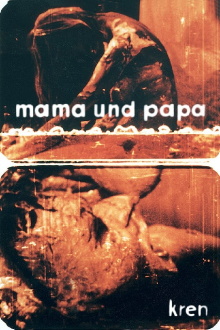
In the first action he filmed, 6/64 Mama und Papa, Kren’s editing leads to many interlocking continuous shots; central takes recur like a leitmotif, circular motion and networking can be observed throughout the film. Kren painstakingly weaves the fury in front of his camera lens into dense geometrical figures. Shot/countershot sequences alternate, lumping back and forth between single (!) frames, they turn the Actionist turmoil into ornaments, rigid geometrical patterns, the equivalent in time to what Mondrian used to distill on canvas in space. (Peter Tscherkassky)
Once upon a time there lived in the same village two men bearing the very same name. One of them chanced to possess four horses, the other had only one horse, so, by way of distinguishing them from each other, the proprietor of four horses was called "Great Claus," and he who owned but one horse was known as "Little Claus".
While fighting in Britain, Roman forces commanded by Caligula capture the noble warrior, Glaucus. Seeing in him gladiator material, Caligula takes Glaucus back to Rome along with other hostages including Glaucus's girlfriend, Ena.
Songs about eternal love, American vagabonds, cowboys and desperadoes, with the romance of railways and trains speeding into the distance are recorded as film songs, and so, for example, in the well-known standard Franck and Johnny you will see M.
A TV adaptation of the classic Alexandre Dumas novel. Edmond Dantes is falsely accused by those jealous of his good fortune, and is sentenced to spend the rest of his life in the notorious island prison, Chateau d'If.
Whips was one of the films mentioned in a half page ad in the April 7, 1966 issue of the Village Voice, advertising The Exploding Plastic Inevitable show at the Dom.
Five swindle stories, taking place in five international cities: Tokyo, Japan ("Fumiko's Five Benefactors" by Hiromichi Horikawa); Amsterdam, The Netherlands ("A River of Diamonds" by Roman Polanski); Naples, Italy ("The Road Map" by Ugo Gregoretti); Paris, France ("The Man Who Sold the Eiffel Tower" by Claude Chabrol); and Marrakesh, Morocco ("The Confidence Man" by Jean-Luc Godard).