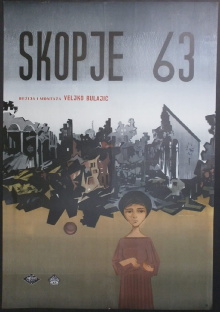
"Skoplje '63" is a 1964 Yugoslavian documentary film directed by Veljko Bulajić about the 1963 Skopje earthquake (Skoplje, per film title, is the Serbo-Croatian spelling of Skopje). The filming started three days after the earthquake and lasted for four months. After that, Bulajić spent 12 months editing the footage at Jadran Film studios.
The amazing story of the animograph, a machine created in France in the sixties by the cartoonist and self-taught inventor Jean Dejoux (1922-2015), whose creation was intended to revolutionize the animation industry.
Take a musical odyssey through five weird and wonderful decades with brothers Ron & Russell Mael, celebrating the inspiring legacy of Sparks: your favorite band’s favorite band.
Chicago 1969: Activists from the Black Panthers, Young Lords, and Young Patriots united African Americans, Latinos, and poor whites to confront police brutality and unfair housing practices in one of America’s most segregated cities.
President Kennedy's birthday celebration was held at the third Madison Square Garden on May 19, 1962, and more than 15,000 people attended, including numerous celebrities.
Archival footage, animation and music are used to look back at the eight anti-war protesters who were put on trial following the 1968 Democratic National Convention.
From 1957 —the year in which the Soviets put the Sputnik 1 satellite into orbit— to 1969 —when American astronaut Neil Armstrong walked on the surface of the moon—, the beginnings of the space conquest were depicted in popular culture: cinema, television, comics and literature of the time contain numerous references to an imagined future.
In 1972, officer Frank Serpico exposes the corruption which poisons the roots of the NYPD and becomes famous in 1973 when director Sidney Lumet tells his story in the classic film “Serpico,” starring Al Pacino.
In this romantic drama, a plain, lonely secretary wins three dance lessons. Her handsome instructor tells her that she is quite talented and cons her into signing a long-term contract.
Once upon a time there lived in the same village two men bearing the very same name. One of them chanced to possess four horses, the other had only one horse, so, by way of distinguishing them from each other, the proprietor of four horses was called "Great Claus," and he who owned but one horse was known as "Little Claus".
While fighting in Britain, Roman forces commanded by Caligula capture the noble warrior, Glaucus. Seeing in him gladiator material, Caligula takes Glaucus back to Rome along with other hostages including Glaucus's girlfriend, Ena.
Songs about eternal love, American vagabonds, cowboys and desperadoes, with the romance of railways and trains speeding into the distance are recorded as film songs, and so, for example, in the well-known standard Franck and Johnny you will see M.