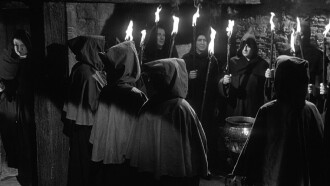
You must have passed through here at least once, says the voiceover commentary during the opening shots of this film. We learn that express trains pass through Meri without stopping and goods trains slow down, but don’t stop. Only the 7:01 commuter train stops, for just a minute, long enough for the teaching staff to alight. Dedicated to all those who live and work in isolated corners of the country, the film conjures up a small, remote world, virtually unknown to wider audiences.
Lucky Jo and his three friends are little criminals, who try to live from small burglaries. But they never have luck - ever so often something inpredictable happens to Jo and gets one of them arrested.
An outdated fireclay factory is due to close, but its long-time employees can't imagine stopping what has fed them all their lives and what they do best.
While fighting in Britain, Roman forces commanded by Caligula capture the noble warrior, Glaucus. Seeing in him gladiator material, Caligula takes Glaucus back to Rome along with other hostages including Glaucus's girlfriend, Ena.
Once upon a time there lived in the same village two men bearing the very same name. One of them chanced to possess four horses, the other had only one horse, so, by way of distinguishing them from each other, the proprietor of four horses was called "Great Claus," and he who owned but one horse was known as "Little Claus".
Five swindle stories, taking place in five international cities: Tokyo, Japan ("Fumiko's Five Benefactors" by Hiromichi Horikawa); Amsterdam, The Netherlands ("A River of Diamonds" by Roman Polanski); Naples, Italy ("The Road Map" by Ugo Gregoretti); Paris, France ("The Man Who Sold the Eiffel Tower" by Claude Chabrol); and Marrakesh, Morocco ("The Confidence Man" by Jean-Luc Godard).
Whips was one of the films mentioned in a half page ad in the April 7, 1966 issue of the Village Voice, advertising The Exploding Plastic Inevitable show at the Dom.