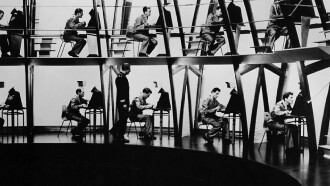
The freshly graduated engineer gradually sobers up from his student ideals and encounters a different reality than he had expected. Few people understand his resistance to the established conditions in a prosperous company, and the hero's personal conflicts with his superiors deepen. He recognises hypocrisy: people say something different from what they really think. He encounters sycophancy and calculation whether he stays in the country or moves to the big city.
Homer is an orphan who was never adopted, becoming the favorite of orphanage director Dr. Larch. Dr. Larch imparts his full medical knowledge on Homer, who becomes a skilled, albeit unlicensed, physician.
In the future, the government maintains control of public opinion by outlawing literature and maintaining a group of enforcers, known as “firemen,” to perform the necessary book burnings.
The incredibly spoiled and overprivileged students of Camden College are a backdrop for an unusual love triangle between a drug dealer, a virgin and a bisexual classmate.
World War I has left golfer Rannulph Junuh a poker-playing alcoholic, his perfect swing gone. Now, however, he needs to get it back to play in a tournament to save the financially ravaged golf course of a long-ago sweetheart.
The BBC's 1965 adaptation of E.M. Forster's novel, screened as part of their Play of the Month strand, adapted by Santha Ramu Rau and John Maynard, and directed by Waris Hussein.
Post-adolescent romance; the dude and the chick both tried to impress each other by pretending to come from rich families, and eventually they'll both have to fess up.
A group of women are workmates at a laundry. Rike is spreading a rumor about the manager Marta, a rumor that Marta is a lesbian and that she once tried to seduce Rike.
CBS bit on Piero Heliczer shooting his film 'Venus in Furs' (they mistakenly call it 'Dirt'). Released by Boo-Hooray as part of their exhibit on Heliczer and The Dead Language Press.
Comments
Have you watched Pre mňa nehrá blues yet? What did you think about it?