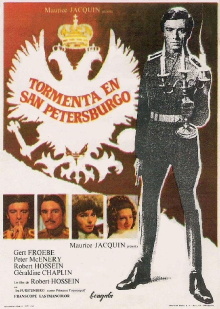
Grigori Rasputin becomes a fixture of Russia's Imperial Court after saving the life of Alexei Nikolaevich, Tsarevich of Russia, the haemophiliac heir to the throne. However as war breaks out, Rasputin's enemies see him as a cause and plot fatal revenge against the Russian mystic.
A pragmatic U.S. Marine observes the dehumanizing effects the U.S.-Vietnam War has on his fellow recruits from their brutal boot camp training to the bloody street fighting in Hue.
14th-century Franciscan monk William of Baskerville and his young novice arrive at a conference to find that several monks have been murdered under mysterious circumstances.
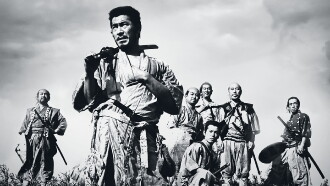
A samurai answers a village's request for protection after he falls on hard times. The town needs protection from bandits, so the samurai gathers six others to help him teach the people how to defend themselves, and the villagers provide the soldiers with food.
A dramatic history of Pu Yi, the last of the Emperors of China, from his lofty birth and brief reign in the Forbidden City, the object of worship by half a billion people; through his abdication, his decline and dissolute lifestyle; his exploitation by the invading Japanese, and finally to his obscure existence as just another peasant worker in the People's Republic.
The lifelong friendship between Rafe McCawley and Danny Walker is put to the ultimate test when the two ace fighter pilots become entangled in a love triangle with beautiful Naval nurse Evelyn Johnson.
During the final weeks of a presidential race, the President is accused of sexual misconduct. To distract the public until the election, the President's adviser hires a Hollywood producer to help him stage a fake war.
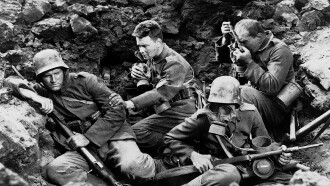
When a group of idealistic young men join the German Army during the Great War, they are assigned to the Western Front, where their patriotism is destroyed by the harsh realities of combat.
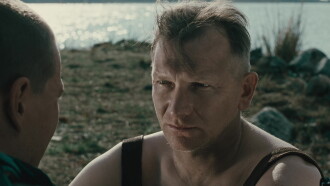
September of 1944, a few days before Finland went out of the Second World War. A chained to a rock Finnish sniper-kamikadze Veikko managed to set himself free.
As Garibaldi's troops begin the unification of Italy in the 1860s, an aristocratic Sicilian family grudgingly adapts to the sweeping social changes undermining their way of life.
"Desire Caught by the Tail" - Described as surrealistic, absurd, and weird. The narrative is nonlinear and the meaning nearly impossible to decipher, the work has been praised despite, and sometimes for, its lack of message.
In the 1930s, bored waitress Bonnie Parker falls in love with an ex-con named Clyde Barrow, and together they start a violent crime spree throughout the country, stealing cars and robbing banks.
A jewel thief crosses paths with a woman carrying a briefcase that the Americans, the Russians and the Chinese all want desperately, so he goes on the run with her figuring that what's inside the case has to be way more valuable than anything he could steal on his own.