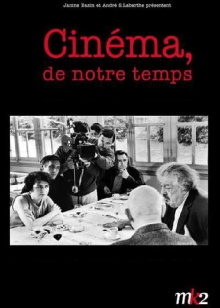
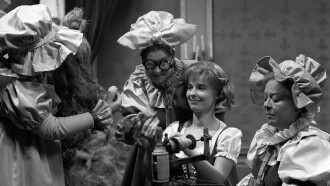
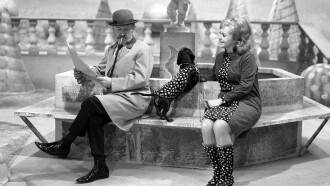
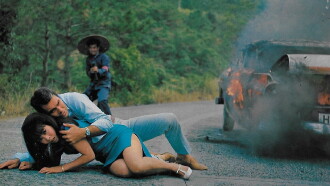
Second in the documentary trilogy from mastermind Jacques Rivette, featuring a conversation between Jean Renoir and Michel Simon, who celebrate their reunion by discussing, among other things, La Chienne (1931) and Boudu Saved from Drowning (1932).
This documentary captures the sounds and images of a nearly forgotten era in film history when African American filmmakers and studios created “race movies” exclusively for black audiences.
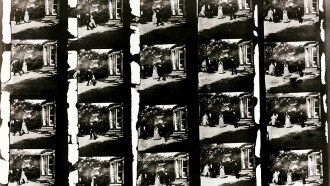
The earliest surviving motion-picture film, and believed to be one of the very first moving images ever created, was shot by Louis Aimé Augustin Le Prince using the LPCCP Type-1 MkII single-lens camera.
Released two years after James Dean's death, this documentary chronicles his short life and career via black-and-white still photographs, interviews with the aunt and uncle who raised him, his paternal grandparents, a New York City cabdriver friend, the owner of his favorite Los Angeles restaurant, outtakes from East of Eden, footage of the opening night of Giant, and Dean's ironic PSA for safe driving.
An insider's account of Jack Warner, a founding father of the American film industry. This feature length documentary provides the rags to riches story of the man whose studio - Warner Bros - created many of Hollywood's most classic films.
When Francois Truffaut approached Alfred Hitchcock in 1962 with the idea of having a long conversation with him about his work and publishing this in book form, he didn't imagine that more than four years would pass before Le Cinéma selon Hitchcock finally appeared in 1966.
Working men and women leave through the main gate of the Lumière factory in Lyon, France. Filmed on 22 March 1895, it is often referred to as the first real motion picture ever made, although Louis Le Prince's 1888 Roundhay Garden Scene pre-dated it by seven years.
In the fall of 1967, intermedia artists Ture Sjölander and Lars Weck collaborated with Bengt Modin, video engineer of the Swedish Broadcasting Corporation in Stockholm, to produce an experimental program called Monument.
... with real-life portraits of Jayne Mansfield, Frak O'Hara, Ruth Ford, Ned Rorem, Virgil Thomson, Claes Oldenburg, Roy Lichtenstein, William Burroughs, Andy Warhol, Rudy Gernreich, Jonas Mekas and others.
American Mark Jason is stranded in Southeast Asia and works there as a teacher. One day, he finds diamonds worth several million dollars in his apartment.
In order to put an end to the numerous ambushes on the gold transports which are a real menace to the finances of the American government, the agent Joe Ford, called Dynamite Joe due to his liking for explosives, is entrusted with controlling the next transfer.
Following the well-received previous film “Confrontation”, Asahi returns as the wandering drifter Manshū Tsuné, who joins forces with the righteous man Hideki.
The boy Mowgli makes his way to the man-village with Bagheera, the wise panther. Along the way he meets jazzy King Louie, the hypnotic snake Kaa and the lovable, happy-go-lucky bear Baloo, who teaches Mowgli "The Bare Necessities" of life and the true meaning of friendship.
Comments
Have you watched Jean Renoir, le patron, 2e partie: La direction d'acteur yet? What did you think about it?