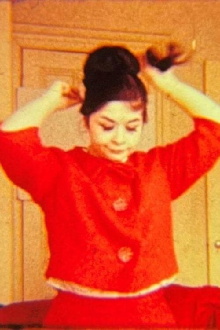
Both a “short story”—a film about a girl who rejects “reality” to live in her own private world—and a film about progressive states of mind. Joan goes to a two-room apartment, removes wigs, false eyelashes, makeup; depressed at her own appearance, she lies on the bed and over-eats. The soundtrack (“It’s my party and I’ll cry if I want to…”) adds irony to her “orgy.” But it is her isolation from human contact, and her entrance into a self-indulgent fantasy world that are central “themes” of the film.
A little girl listens to a violinist playing on the bank of a river. The little girl wants to learn to play the instrument and asks the musician to teach her.
Stranded on a desolate road, a man ventures into the unforgiving desert in search of help. As the scorching heat and relentless thirst take their toll, he begins to see mirages that blur the line between illusion and reality.
... with real-life portraits of Jayne Mansfield, Frak O'Hara, Ruth Ford, Ned Rorem, Virgil Thomson, Claes Oldenburg, Roy Lichtenstein, William Burroughs, Andy Warhol, Rudy Gernreich, Jonas Mekas and others.
Following the well-received previous film “Confrontation”, Asahi returns as the wandering drifter Manshū Tsuné, who joins forces with the righteous man Hideki.
In the fall of 1967, intermedia artists Ture Sjölander and Lars Weck collaborated with Bengt Modin, video engineer of the Swedish Broadcasting Corporation in Stockholm, to produce an experimental program called Monument.