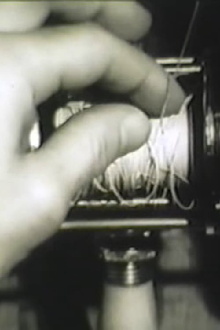
“In their starkly minimal film, The Awful Backlash, directors Robert Nelson and William Allan, focus solely on a pair of hands as they begin to unravel what appears to be a tangled fishing line. Any further evidence of the title’s confusing ‘awfulness’ – other than the literal disentanglement of the line remains, however, tentative, left as it were, literally, at a loose end. The viewer knows nothing of the incident that led to this backlash or entanglement; nor of the directors’ initial motive for the title indeed not of any other attempt at blending an additional storyline beyond what is seen. There is, perhaps, one link with a reverse reaction – a sense of gradual recovery taking place, as the thread unfolds from a position of multiplicity back to a singular line.” (Pamela Kember, Rethinking Refunctioning, ‘Awful Backlash’ catalogue, May 2000) Preserved by the Academy Film Archive in 2005.
As the west rapidly becomes civilized, a pair of outlaws in 1890s Wyoming find themselves pursued by a posse and decide to flee to South America in hopes of evading the law.
From the moment she glimpses her idol at the stage door, Eve Harrington is determined to take the reins of power away from the great actress Margo Channing.
While filing for a divorce, beautiful ex-stripper Roslyn Taber ends up meeting aging cowboy-turned-gambler Gay Langland and former World War II aviator Guido Racanelli.
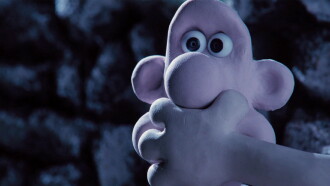
Wallace's whirlwind romance with the proprietor of the local wool shop puts his head in a spin, and Gromit is framed for sheep-rustling in a fiendish criminal plot.
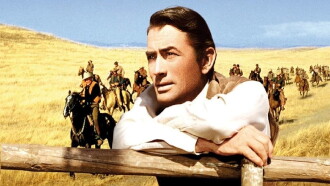
Retired wealthy sea captain Jim McKay arrives in the Old West, where he becomes embroiled in a feud between his future father-in-law, Major Terrill, and the rough and lawless Hannasseys over a valuable patch of land.
Wallace and Gromit have run out of cheese, and this provides an excellent excuse for the duo to take their holiday to the moon, where, as everyone knows, there is ample cheese.
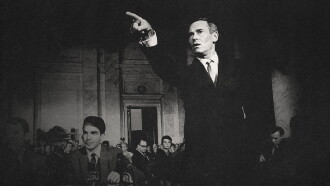
Proposed by the President of the United States to fill the post of Secretary of State, Robert Leffingwell appears before a Senate committee, chaired by the idealistic Senator Brig Anderson, which must decide whether he is the right person for the job.
In order to put an end to the numerous ambushes on the gold transports which are a real menace to the finances of the American government, the agent Joe Ford, called Dynamite Joe due to his liking for explosives, is entrusted with controlling the next transfer.
A jewel thief crosses paths with a woman carrying a briefcase that the Americans, the Russians and the Chinese all want desperately, so he goes on the run with her figuring that what's inside the case has to be way more valuable than anything he could steal on his own.