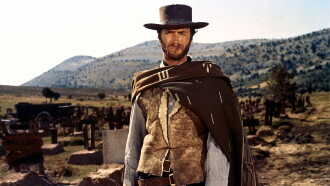
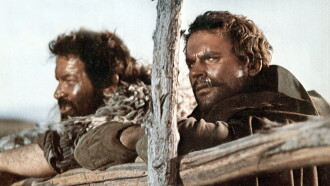
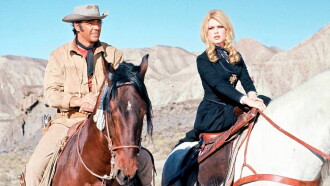
A young cowboy, Johnny, playing in a rigged poker game is forced to shoot one of the other players. The cowboy takes quick leave as he is accused of murder and a reward for his capture is posted. After being wounded, he finds refuge on a ranch and becomes involved with the family. While he is away, a gang of Mexicans kills the McGowan family except for Sally, who manages to escape and find Johnny who is now out for revenge.
While the Civil War rages on between the Union and the Confederacy, three men – a quiet loner, a ruthless hitman, and a Mexican bandit – comb the American Southwest in search of a strongbox containing $200,000 in stolen gold.
Jack Beauregard, an aging gunman of the Old West, only wants to retire in peace and move to Europe, but a young gunfighter known as "Nobody" who idolizes Beauregard wants him to go out in a blaze of glory.
Half-breed Keoma returns to his border hometown after service in the Civil War and finds it under the control of Caldwell, an ex-Confederate raider, and his vicious gang of thugs.
A coffin-dragging gunslinger and a prostitute become embroiled in a bitter feud between a Klan of Southern racists and a band of Mexican Revolutionaries.
1907 Central America: Maria II is the daughter of an Irish terrorist. After her father's death, she meets Maria I, a performer, and decides to stay with the circus, and on her debut as a singer, unintentionally invents the striptease and makes the circus famous.
Lucky Luke becomes the Sheriff of Daisy Town and runs out all the criminals. Then the Dalton brothers arrive and try to get the Indians to break the peace treaty and attack the town.
Five criminals are arrested after a bank-robbery. One escapes, and the police officer in charge of transporting them arrests a new person at random to cover up for his negligence.
Centring on the legend of the four ancient Chinese heroines, the film was a novelty for audiences at the time, as the singing performance was in Cantonese and used huangmei operatic rhythms—a popular trend in the 1960s, yet it retained traditional flavours by using operatic luogu percussion in the battle scenes.
There's nothing like a good, opulent, gaudy musical to lift the spirits, but when it's a 1960's Hong Kong musical orchestrated by a Japanese director and composer, it breaks through the ranks as a classic of campy kitsch.
Comments
Have you watched If You Want to Live... Shoot! yet? What did you think about it?