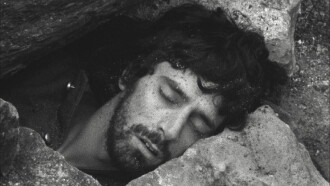
June 10, 1968. After the end of a long strike in the Wonder factory in Saint-Ouen (France), a female worker is dissatisfied with the negotiated compromise and refuses to return to work. Originally, it was a scene of Willemont's Sauve qui peut Trotsky, but the film was never completed.
Three identical prints of a single 100 foot fixed-camera take are shown from beginning to end-roll light-flare, with a few feet of blackness preceding/bridging/following the rolls.
Centring on the legend of the four ancient Chinese heroines, the film was a novelty for audiences at the time, as the singing performance was in Cantonese and used huangmei operatic rhythms—a popular trend in the 1960s, yet it retained traditional flavours by using operatic luogu percussion in the battle scenes.
The Three Kingdoms period begins as the walled fortress of Hsin Yang falls to invaders. Centered around this historical event, The Last Days of Hsin Yang follows the escape of the prince of Hsin Yang as he hides with a small family and escapes from the sacked and burning city.
Five criminals are arrested after a bank-robbery. One escapes, and the police officer in charge of transporting them arrests a new person at random to cover up for his negligence.
Two young boys, play hooky from school in order to explore an ultramodern world's fair. They take in the many marvelous scientific and industrial exhibits, obtain literature, eat food, and generally run amok.