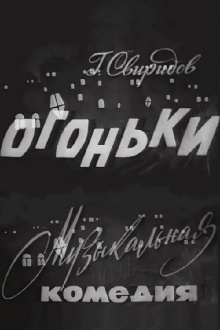
A TV play based on Georgy Vasilyevich Sviridov's operetta "Ogonyki" (libretto by L. Trauberg). It tells the story of the revolutionary struggle of the workers at the Narva Gate in St. Petersburg in the spring of 1903.
Five criminals are arrested after a bank-robbery. One escapes, and the police officer in charge of transporting them arrests a new person at random to cover up for his negligence.
There's nothing like a good, opulent, gaudy musical to lift the spirits, but when it's a 1960's Hong Kong musical orchestrated by a Japanese director and composer, it breaks through the ranks as a classic of campy kitsch.
A group of Northern vigilantes, roaming the post Civil War south, attack and kill the fiancee of war veteran Brian, who is rescued by his friend, Daniel.
Centring on the legend of the four ancient Chinese heroines, the film was a novelty for audiences at the time, as the singing performance was in Cantonese and used huangmei operatic rhythms—a popular trend in the 1960s, yet it retained traditional flavours by using operatic luogu percussion in the battle scenes.
Two young boys, play hooky from school in order to explore an ultramodern world's fair. They take in the many marvelous scientific and industrial exhibits, obtain literature, eat food, and generally run amok.
Forced behind British lines by engine problems, the Red Baron camouflages his plane, swaps uniforms with a dead soldier, and, posing as a Belgian, makes his way to a hospital.
A Southern soldier in the American Civil War is sent to reconnoiter the enemy positions and becomes trapped beneath a huge pile of rubble by Northern cannon fire.