A plot by an evil mastermind to eliminate the lead singer of the Japanese "Group Sounds" rock band, The Jaguars, leads the group through a series of psychedelic, comedic escapades.
Singer Freddie Mercury, guitarist Brian May, drummer Roger Taylor and bass guitarist John Deacon take the music world by storm when they form the rock 'n' roll band Queen in 1970.
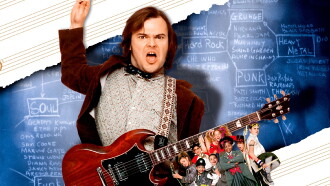
Fired from his band and hard up for cash, guitarist and vocalist Dewey Finn finagles his way into a job as a fifth-grade substitute teacher at a private school, where he secretly begins teaching his straight-A students the finer points of rock 'n' roll and the power of sticking it to the man.
After a celebratory drink goes wrong, Looney accidentally kills the lead singer of his band. He must pull his bandmates into a cover-up before it is too late.
No Love Lost rocketed to fame and made its members stars. Guitarist Tony has drunk himself to poverty when a message reaches him: after years of sobriety, singer Katarina has relapsed and is in dire straits.
After a disastrous concert, Gloria, the guitarist, and Paula, the drummer, and Mikel, the singer, find themselves locked in the dressing room because of the angry fans waiting for them outside.
After failing to make it big as a rock band, four Indian Americans in 1960s San Francisco attempt one last rebrand to ride the hippie wave and finally get their big break.
The adventures of a small town Croatian family during the 1960s. The decade will leave eternal marks on all of their members, but most of the story focuses on the youngest one, a boy, Frula, who discovers the love and fashion of the time.
A young couple, Rosemary and Guy, moves into an infamous New York apartment building, known by frightening legends and mysterious events, with the purpose of starting a family.
A baleful limping man walks through Prague. He is Asmodeus (Juraj Herz), the fiend of lustfulness, entertaining himself by putting together by magic couples of lovers.
Centring on the legend of the four ancient Chinese heroines, the film was a novelty for audiences at the time, as the singing performance was in Cantonese and used huangmei operatic rhythms—a popular trend in the 1960s, yet it retained traditional flavours by using operatic luogu percussion in the battle scenes.