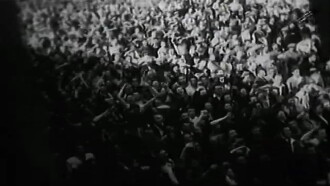
This film focuses on the Spanish Civil War that occurred in the 1930s as a result of the attempted Communist takeover of the Republican government. It documents how a handful of infiltrators and agitators were able to capture the country while the majority was either fooled by slogans of promised reform or frightened by acts of terrorism into non-resistance. This documentary was produced by the Committee to Research the Spanish War Knoxville, Tennessee
In july 1936, the civil war began in Spain, and it would last three years. Since then, it has constantly been a subject for fascination and controversy.
In July 1936, the Spanish people resist the offensive by Franco’s army, backed by Italian and German fascists, aimed at conquering the country's major cities.
Popular movie trailers from 1968
These some of the most viewed trailers for movies released in 1968:
The Three Kingdoms period begins as the walled fortress of Hsin Yang falls to invaders. Centered around this historical event, The Last Days of Hsin Yang follows the escape of the prince of Hsin Yang as he hides with a small family and escapes from the sacked and burning city.
A baleful limping man walks through Prague. He is Asmodeus (Juraj Herz), the fiend of lustfulness, entertaining himself by putting together by magic couples of lovers.
"In my film I suggest that there is no greater mystery than that of the protagonists. War and Love are simply equated for what they are; the aftermath is inevitable, and a normal human condition, for which like the ancients one can only have pity and understanding.
Two young boys, play hooky from school in order to explore an ultramodern world's fair. They take in the many marvelous scientific and industrial exhibits, obtain literature, eat food, and generally run amok.
Centring on the legend of the four ancient Chinese heroines, the film was a novelty for audiences at the time, as the singing performance was in Cantonese and used huangmei operatic rhythms—a popular trend in the 1960s, yet it retained traditional flavours by using operatic luogu percussion in the battle scenes.
There's nothing like a good, opulent, gaudy musical to lift the spirits, but when it's a 1960's Hong Kong musical orchestrated by a Japanese director and composer, it breaks through the ranks as a classic of campy kitsch.
Three identical prints of a single 100 foot fixed-camera take are shown from beginning to end-roll light-flare, with a few feet of blackness preceding/bridging/following the rolls.