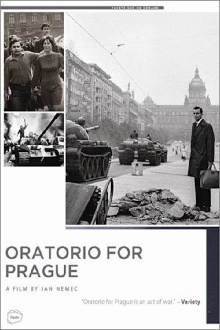
A unique document of the 1968 Soviet invasion of Czechoslovakia, what began as a documentary about the liberalization of Czechoslovakia evolved into a record of the entry of Russian tanks into Prague.
How does it feel like to become an occupier without your own intentions? With known but also never published archival materials from the whole Europe and Russia we tell a family story of the director Anna Kryvenko about how the big politics is destroying the lives of ordinary people.
Reinhard Heydrich was considered the most dangerous man in Nazi Germany after Hitler himself. The plot to kill him masterminded in England and carried through to finality in Prague in 1942, is told in this gripping dramatised documentary special.
Filmmaker Amir Bar-Lev follows two Czech Holocaust survivors, Jan Weiner and Arnost Lustig, as they revisit Terezin, a labor camp where Arnost was interned for five years and Jan's mother was murdered.
A film about the contrasts between Czechoslovakia and Bulgaria in 1968. A film that reveals the mechanisms of censorship and propaganda during communism.
From the behavior, discourse, and appearance of individual actors, Vachek composes, in the form of a mosaic, a broad and many-layered film-argument about Czechoslovak democracy in the period of its rebirth, all administered with the director’s inimitable point of view.
Alternative movies trailers for Oratorio for Prague
More movie trailers, teasers, and clips from Oratorio for Prague:
Oratorio For Prague | Trailer
One of the most powerful documentaries ever made Oratorio for Prague contains the only footage from the Soviet-led invasion of Prague in 1968. Czech New ...
Popular movie trailers from 1968
These some of the most viewed trailers for movies released in 1968:
Two young boys, play hooky from school in order to explore an ultramodern world's fair. They take in the many marvelous scientific and industrial exhibits, obtain literature, eat food, and generally run amok.
Five criminals are arrested after a bank-robbery. One escapes, and the police officer in charge of transporting them arrests a new person at random to cover up for his negligence.
Three identical prints of a single 100 foot fixed-camera take are shown from beginning to end-roll light-flare, with a few feet of blackness preceding/bridging/following the rolls.