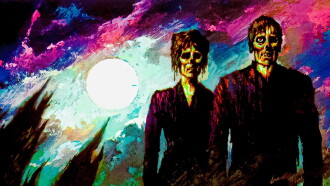
After film school, Godina’s first professional work as a director was “Picnic on Sunday,” a 1968 black-and-white short without any words that shows how seven different people spend a Sunday. A simple concept, but in Godina’s hands the short is suffused with both sexuality and revolution. - Paste
It is the story of an old man - Gulam - and the cherry tree which grew in his garden. As the story opens, the village children consider Gulam their best friend.
A group of Swedish tourists are on the way to a Russian village to witness the so called 'Festivity of Neptunus', in which the inhabitants take a dive in a hole in the ice.
Sometimes the most beautiful men harbor the ugliest secrets. Two guys are naked in bed, having sex. One man gets up, uses the bathroom, gets dressed, says, "Goodbye, see ya 'round," and leaves.
Fragments of a Saturday winter day. The Vittenzein brothers are alone at their family house. Mateo stops by to pick up Bruno and Camilo and drive them to the country house where their mother awaits.
A young guy gets caught on a currency transaction, changing rubles to dollars. But in his mind, he has long overcome not only state borders, but also the laws of gravity.
The pair of mannequins in the mattress section seem the ideal couple: Handsome, elegant and perfect. But when the mall closes and the lights go out, things are quite different.
Popular movie trailers from 1968
These some of the most viewed trailers for movies released in 1968:
Anthony Steffen, as a young gunman who works as a circus performer, witnesses the killing of some outlaws, carried out by their leader and is credited with the deed.
Centring on the legend of the four ancient Chinese heroines, the film was a novelty for audiences at the time, as the singing performance was in Cantonese and used huangmei operatic rhythms—a popular trend in the 1960s, yet it retained traditional flavours by using operatic luogu percussion in the battle scenes.
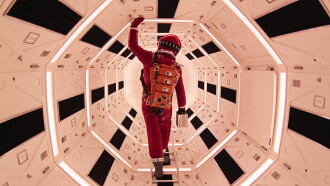
Humanity finds a mysterious object buried beneath the lunar surface and sets off to find its origins with the help of HAL 9000, the world's most advanced super computer.