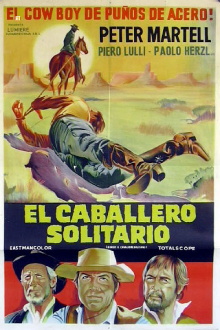
A town is being terrorized by a gang of marauders led by Bill Anderson, a clever bandit boss. The town's leadership is deciding to do something against the problem, but it does not believe bringing in the military will be a solution. It is agreed upon that they will request help from the well-known Pinkerton agency. At the same time, Ringo, a gunslinger, is chasing after the bandits. He suspects a deeper-sitting conspiracy than random bandit assaults. He joins forces with the newly arrived under cover Pinkerton agent, to uncover a plot between a local businessman, the Mexican revolution and bandit's heist loot of gold. But the bandits have long planned to move on. Disguised as Mormons, they are moving west to start a new life of farming during the day and robbing stage coaches at night. Ringo and the agent track them down....
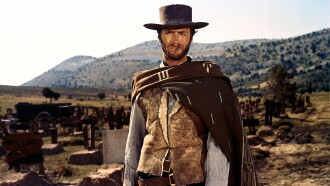
While the Civil War rages on between the Union and the Confederacy, three men – a quiet loner, a ruthless hitman, and a Mexican bandit – comb the American Southwest in search of a strongbox containing $200,000 in stolen gold.
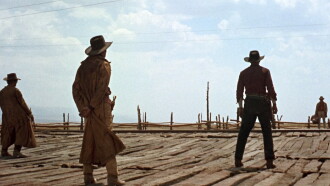
As the railroad builders advance unstoppably through the Arizona desert on their way to the sea, Jill arrives in the small town of Flagstone with the intention of starting a new life.
The two brothers Trinity and Bambino are exchanged by two federal agents and take advantage of the situation to steal a huge booty hidden in a monastery by a gang of outlaws.
The simple story has the pair coming to the rescue of peace-loving Mormons when land-hungry Major Harriman sends his bullies to harass them into giving up their fertile valley.
At the beginning of the 1913 Mexican Revolution, greedy bandit Juan Miranda and idealist John H. Mallory, an Irish Republican Army explosives expert on the lam from the British, fall in with a band of revolutionaries plotting to strike a national bank.
A coffin-dragging gunslinger and a prostitute become embroiled in a bitter feud between a Klan of Southern racists and a band of Mexican Revolutionaries.
Jack Beauregard, an aging gunman of the Old West, only wants to retire in peace and move to Europe, but a young gunfighter known as "Nobody" who idolizes Beauregard wants him to go out in a blaze of glory.
A young couple, Rosemary and Guy, moves into an infamous New York apartment building, known by frightening legends and mysterious events, with the purpose of starting a family.
Two young boys, play hooky from school in order to explore an ultramodern world's fair. They take in the many marvelous scientific and industrial exhibits, obtain literature, eat food, and generally run amok.
Three identical prints of a single 100 foot fixed-camera take are shown from beginning to end-roll light-flare, with a few feet of blackness preceding/bridging/following the rolls.