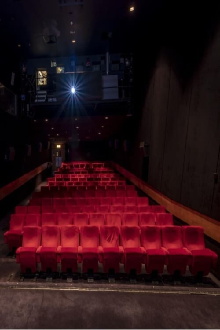
Morgan Fisher’s Screening Room (1968–) is a tracking shot of the movie theatre in which the film is exhibited, and thus must be remade each time it is shown in a new location. —Erika Balsom
There's nothing like a good, opulent, gaudy musical to lift the spirits, but when it's a 1960's Hong Kong musical orchestrated by a Japanese director and composer, it breaks through the ranks as a classic of campy kitsch.
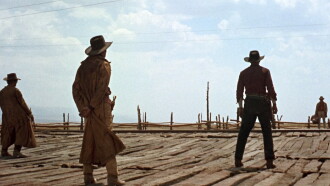
As the railroad builders advance unstoppably through the Arizona desert on their way to the sea, Jill arrives in the small town of Flagstone with the intention of starting a new life.
A Southern soldier in the American Civil War is sent to reconnoiter the enemy positions and becomes trapped beneath a huge pile of rubble by Northern cannon fire.
The Three Kingdoms period begins as the walled fortress of Hsin Yang falls to invaders. Centered around this historical event, The Last Days of Hsin Yang follows the escape of the prince of Hsin Yang as he hides with a small family and escapes from the sacked and burning city.
Two young boys, play hooky from school in order to explore an ultramodern world's fair. They take in the many marvelous scientific and industrial exhibits, obtain literature, eat food, and generally run amok.
Centring on the legend of the four ancient Chinese heroines, the film was a novelty for audiences at the time, as the singing performance was in Cantonese and used huangmei operatic rhythms—a popular trend in the 1960s, yet it retained traditional flavours by using operatic luogu percussion in the battle scenes.