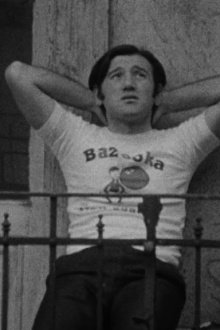
This is a portrait of Peter Weibel, and at the same time a reflection on the medium film. As Peter Weibel looks silently into the camera (and thus to the audience) his own difficult text on the subject "Nimm eine Handvoll Zelluloid" ("Take a handful of celluloid;" published as Werkstatt Blatt 3, ed. Gottfried Schlemmer) is heard in his own voice. Due to the complexity of human language and the imperfection of the human ear, this linguistic information can only be imperfectly communicated to the audience. A film about the difference between cinema and literature. (E.S.jr.)
Two young boys, play hooky from school in order to explore an ultramodern world's fair. They take in the many marvelous scientific and industrial exhibits, obtain literature, eat food, and generally run amok.
There's nothing like a good, opulent, gaudy musical to lift the spirits, but when it's a 1960's Hong Kong musical orchestrated by a Japanese director and composer, it breaks through the ranks as a classic of campy kitsch.
Centring on the legend of the four ancient Chinese heroines, the film was a novelty for audiences at the time, as the singing performance was in Cantonese and used huangmei operatic rhythms—a popular trend in the 1960s, yet it retained traditional flavours by using operatic luogu percussion in the battle scenes.
In a Canadian mountain resort, Vixen Palmer resides with her naive pilot husband Tom. While he's away flying in tourists, she sleeps with practically everybody including a husband and his wife, and even her biker brother.
"In my film I suggest that there is no greater mystery than that of the protagonists. War and Love are simply equated for what they are; the aftermath is inevitable, and a normal human condition, for which like the ancients one can only have pity and understanding.
Comments
Have you watched The Act of Thinking yet? What did you think about it?