Gabriel Pelletier, sales manager for a major industrial firm, would be the happiest of men if he didn't have a family of rare originality. The day Gabriel Pelletier is asked by the firm's management to welcome and accommodate an important American industrialist who has come to Paris to handle a major contract, he realizes the difficulties that lie ahead. How will Mr. Strumberger, who has the reputation of a fierce puritan, react to the behavior of the various members of the family?
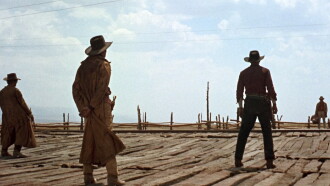
Anthony Steffen, as a young gunman who works as a circus performer, witnesses the killing of some outlaws, carried out by their leader and is credited with the deed.
"In my film I suggest that there is no greater mystery than that of the protagonists. War and Love are simply equated for what they are; the aftermath is inevitable, and a normal human condition, for which like the ancients one can only have pity and understanding.
There's nothing like a good, opulent, gaudy musical to lift the spirits, but when it's a 1960's Hong Kong musical orchestrated by a Japanese director and composer, it breaks through the ranks as a classic of campy kitsch.
Centring on the legend of the four ancient Chinese heroines, the film was a novelty for audiences at the time, as the singing performance was in Cantonese and used huangmei operatic rhythms—a popular trend in the 1960s, yet it retained traditional flavours by using operatic luogu percussion in the battle scenes.
Two young boys, play hooky from school in order to explore an ultramodern world's fair. They take in the many marvelous scientific and industrial exhibits, obtain literature, eat food, and generally run amok.
Forced behind British lines by engine problems, the Red Baron camouflages his plane, swaps uniforms with a dead soldier, and, posing as a Belgian, makes his way to a hospital.