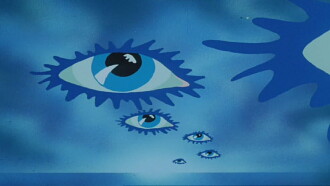
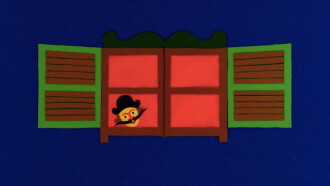
Remake of the 1960 film with the same name in color that tells the story of a man and a woman who go by raft to a remote desert island with chickens and a dog. At first, it is a kind of paradise for them. They farm and fish following the same routine every day, feasting on grilled sanma that they roast out in the open. One day, their harmony gets interrupted by a mustachioed scientist on a raft powered by an abused pig. This unwanted visitor constructs a robot which begins the process of industrialization on the island. The couple are disgruntled but decide to put up with the man and his technology.
An animated visual interpretation of the song "Autobahn," by German electronic pioneers Kraftwerk. A fast-paced experimental film which proved to be a groundbreaking combination of electronic and manual animation.
In Eshbaugh’s ‘political’ animated cartoon world, the Democratic platform is destroyed by its own swallowing of the NRA (National Recovery Act), sending the Donkey representing the party into a dizzying disastrous bucking fury (thanks to a ‘liberal’ added dose of Russian vodka).
Burr creates a slow, liminal illusion in black-and-white, switching perspectives and matrices and crescendo-ing in time with Christopher Doulgeris’ portentously pulsating soundtrack.
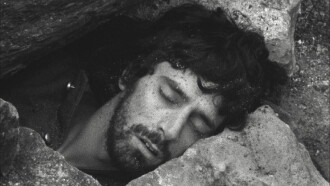
A Southern soldier in the American Civil War is sent to reconnoiter the enemy positions and becomes trapped beneath a huge pile of rubble by Northern cannon fire.
The Three Kingdoms period begins as the walled fortress of Hsin Yang falls to invaders. Centered around this historical event, The Last Days of Hsin Yang follows the escape of the prince of Hsin Yang as he hides with a small family and escapes from the sacked and burning city.