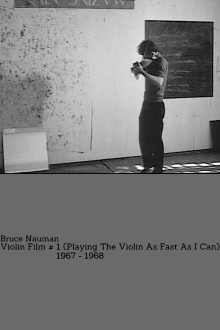
Violin Film #1 (Playing the Violin as Fast as I Can), is one of several 1967-68 films featuring Nauman's violin-playing, in which the production of sound is subjected to procedural strategies that problematize its status as music and performance.
The dramatic story of Egon Schiele in his own words, celebrating his remarkable artistic achievements but also debating the controversies around his work.
An intimate journey through the formative years of David Lynch's life. From his idyllic upbringing in small town America to the dark streets of Philadelphia, we follow Lynch as he traces the events that have helped to shape one of cinema's most enigmatic directors.
Documentary that exposes the secret world of these unknown tax havens. There is a global network of tax-free storage facilities valuable goods, catering to the super rich - and it's virtually unknown, until now.
The inspiring story about the professional rock smasher Clive Tapps. A devoted man who plans to fulfill his dream, to smash the biggest rock he has ever faced.
The Mona Lisa Curse is a Grierson award-winning polemic documentary by art critic Robert Hughes that examines how the world's most famous painting came to influence the art world.
Light is the first bodily form pays homage to the philosopher of light, Robert Grosseteste. The title is intended to be somewhat tongue-in-cheek since this video was made entirely in the dark, using only a circuit bent Webcam.
Tracing the Future follows In the Wake exhibition artist Naoya Hatakeyama as he photographs the devastated landscape of his hometown of Rikuzentakada after 3/11.
Documentary in which art critic Waldemar Januszczak argues that beauty is still to be found in modern art, despite several recent books claiming the contrary.
Popular movie trailers from 1968
These some of the most viewed trailers for movies released in 1968:
"In my film I suggest that there is no greater mystery than that of the protagonists. War and Love are simply equated for what they are; the aftermath is inevitable, and a normal human condition, for which like the ancients one can only have pity and understanding.
Sam Moran is a Honolulu charter-boat captain who leads fishing expeditions in the tropical paradise. When his daughter is found murdered at the party of a wealthy young playboy, he seeks the truth about the murder.
Three identical prints of a single 100 foot fixed-camera take are shown from beginning to end-roll light-flare, with a few feet of blackness preceding/bridging/following the rolls.
Documentary by Juan Francisco de Lasa about a pioneer of Spanish cinema. Gelabert attended one of the first sessions of the Lumière's cinématographe in Barcelona.
The Three Kingdoms period begins as the walled fortress of Hsin Yang falls to invaders. Centered around this historical event, The Last Days of Hsin Yang follows the escape of the prince of Hsin Yang as he hides with a small family and escapes from the sacked and burning city.
A Southern soldier in the American Civil War is sent to reconnoiter the enemy positions and becomes trapped beneath a huge pile of rubble by Northern cannon fire.
Comments
Have you watched Violin Film #1 (Playing The Violin As Fast As I Can) yet? What did you think about it?