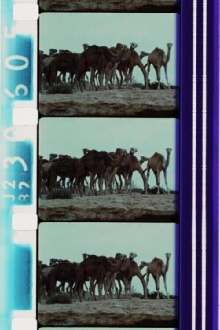
Nancy Graves statement, 1971: "Izy Boukir contains footage filmed in the Sahara during eighteen days. I wanted to extend sequences [from earlier films] and to a greater degree permit the animal motions to determine structure. An Arriflex [camera] was often positioned five to ten feet from the animals. In New York, partite animal forms were separated into two segments: as walking and as graduated motion. Through the edited sequential duration, camel morphology vies with the viewer's inherent anthropomorphism. For me this film is the most successful in that the impression of these animals as primordial beings existing in barren yet awesomely beautiful surroundings far outweighs a consciousness of complicated editing and sound relationships."
At least forty films have been made about the Living Theatre; it remained to the American underground filmmaker Sheldon Rochlin (previously responsible for the marvellous Vali) to make the 'definitive' film about one of the most famous of their works, Paradise Now, shot in Brussels and at the Berlin Sportpalast.
Rosana is an attractive teacher who is losing his youth with such discipline in the study. When suddenly bursts into his life a perfect cheeky who lives of game and odd jobs as photographer, but wants to acquire a little culture for personal reasons.
The world is divided into factions, on opposite sides of issues; each side is, of course, right. And so the gap between the people grows, until someone challenges the absolutist view of what's "right.
A homage to nature and a plea for a careful approach to it. In one of his early films, Jon Jost shows impressions of a stream in the forest and a couple streaming through the forest: direct looks into the camera, cross-fades, multiple exposures, playing with sunlight, shadows and shapes.