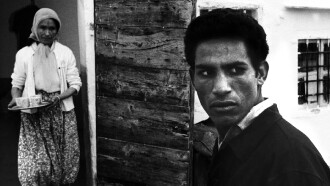
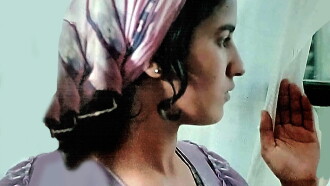
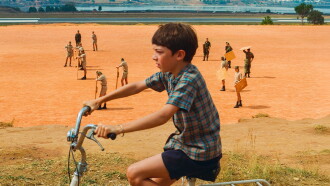
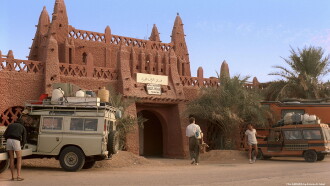
In a village on the edge of the Sahara, Rima, a 19-year-old orphan, dreams of learning, of discovering, of living free while the men of the salt mine go on strike. The authorities react by sending the army, Rima decides to help the strikers by trapping the soldiers. Co-produced with the Office des Actualités Algériens and shot in the region of Téhouda, 50 kilometers from Biskra, this Franco-Algerian film is fully part of the cinematographic heritage of both shores of the Mediterranean. Bertuccelli adopts the technique of cinema verite, with non-professional actors from the village itself, giving the film a striking documentary texture and a rare force of authenticity. Carried by the moving interpretation of Leila Shenna in the role of Rima, the actor Krikèche and lulled by the music of Taos Amrouche, the film questions female emancipation, social resistance and the relationship with the territory.
A man befriends a fellow criminal as the two of them begin serving their sentence on a dreadful prison island, which inspires the man to plot his escape.
Former petty criminal Ali la Pointe becomes a commander of the Algerian Front de Liberation Nationale, directing a guerilla insurgency against the colonial French occupation.
In colonial Vietnam, dashing French naval captain Jean-Baptiste, wealthy plantation owner Éliane Devries, and her adopted Vietnamese daughter Camillevare form the three points of a cross-cultural romantic triangle.
Néfissa, a student in Algiers, returns to her village in the south in the summer. Her father wants her to marry the mayor but she wants to continue her studies.
Omar, better known as Omar the Strawberry, is an old-fashioned bandit. Forced to flee to Algeria, he makes a living out of petty crime, accompanied by his famous sidekick Roger.
At the outbreak of the Second World War, two friends, Mokrane and Menach, abruptly interrupt their studies and return to their remote native Kabylian village of Tagsa.
At least forty films have been made about the Living Theatre; it remained to the American underground filmmaker Sheldon Rochlin (previously responsible for the marvellous Vali) to make the 'definitive' film about one of the most famous of their works, Paradise Now, shot in Brussels and at the Berlin Sportpalast.
"Canada's convention-shattering voice of poetry" (Globe and Mail). Michael Ondaatje documents the work and spirit of fellow poet bpNichol (1944-1988) Capturing the artist / writer / sound performer in "fantasy documentary", Ondaatje uncovers what made bpNichol an influence to a generation of North American and European writers.
The simple story has the pair coming to the rescue of peace-loving Mormons when land-hungry Major Harriman sends his bullies to harass them into giving up their fertile valley.