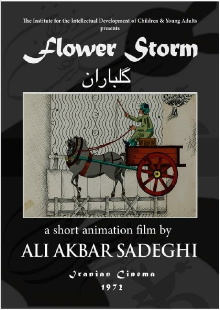
Sadeghi’s second film made in 1972, advances his style by accentuating on modern usage of Persian miniatures. The story gets along with the hippism ambience of 1970’s about peace. Flower Storm tells of the inhabitants of two towns who lives in peace and harmony until their kings start to fight over a bird they both have shot down while hunt-ing. War breaks out but children of the town during the night, substitute flowers for the cannon balls. The next day, there exists not a battle but flower storm.
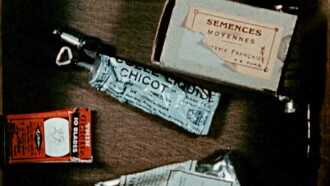
Featuring a commentary by Noël Burch (in nonsense French), Recreation's rapid-fire montage of single-frame images of incredible density and intensity has been compared to contemporary Beat poetry.
Trixie can't wait to bring Knuffle Bunny to school and show him off. But an awful surprise awaits her: someone else has the exact same bunny! Thus begins an exciting, frustrating and ultimately revelatory twenty-four hours of chaos, where Trixie loses her beloved bunny and gains him back, along with something new: her very first best friend.
An untidy room. Empty beer tins, empty wine bottles, a half-empty glass of whisky... A girl is getting up absent-mindedly and starts preparing herself.
“It’s not how it used to be.” The words of Cézar Néwashish resonate throughout this short documentary that explores the history of the Atikamekw community of Manawan, Quebec.
In a French seaside town, at a boarding house for civil servants recovering from surgery and maladies, the six male residents' lives change dramatically when two women arrive: Catherine, lively, sexually liberated, willing to kiss, dance, and sleep with the men, and Leonie, reserved, formal, conservative.
Jack White throws a big party at which many of the artists he has produced perform. He has had an eventful life in which he has always remained true to his ideals, first as a footballer, then as a pop singer and then as a producer, even in the face of fierce opposition from others.
Comments
Have you watched Flower Storm yet? What did you think about it?