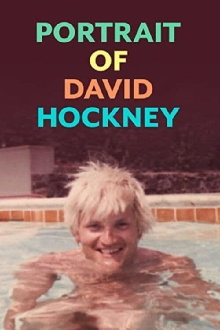
Filmed at the time Hockney was painting Mr and Mrs Clark and Percy, Portrait of David Hockney is made up of a limited number of shots, observing the periphery details of his flat and studio. Each view is held so as to focus on its particular qualities and composition and, with the accompanying soundtrack of off-screen phone calls, conversations and musings, builds up a picture of Hockney’s daily life.
Commercial and technical developments on British Rail: new freight loads, air conditioned carriages, an ultrasonic test-train for checking the permanent way, a lecture train, and a new station for motorists - all part of the railway scene in the 1970's.
Report No. 8 in a series of 13 topical films, produced since the far reaching plan for the modernisation and re-equipment of British Railways in 1955 started to take effect, to log the many developments - new services, equipment, techniques - wherever these have been introduced.
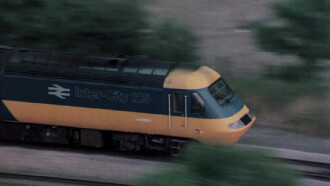
A high speed Inter-City train is the star of this impressionist film in which picture and music are brought together to enhance the mood and rhythm of the subject and hail the arrival of 125mph regular passenger services.
An ambigious “love story” told through the 1930’s archive of a British archaelogist who took a camera on his digs in the British mandate for Palestine and fell in love with his Bedouin assistant.
In a bid to encourage city-dwellers to leave behind the restrictions of war, 'The Green Girdle' escapes from the austere urban landscape of inner-city London and savours the natural delights of the capital’s rural surroundings.
The City of Sheffield is renewing itself, but until recently Sheffield's railway network exemplified the confusion and inefficiency created by competitive railway expansion in Victorian times.
Popular movie trailers from 1972
These some of the most viewed trailers for movies released in 1972:
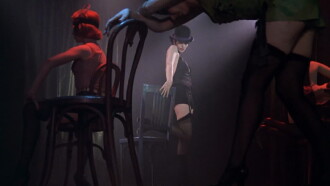
Inside the Kit Kat Club of 1931 Berlin, starry-eyed singer Sally Bowles and an impish emcee sound the clarion call to decadent fun, while outside a certain political party grows into a brutal force.
Jack White throws a big party at which many of the artists he has produced perform. He has had an eventful life in which he has always remained true to his ideals, first as a footballer, then as a pop singer and then as a producer, even in the face of fierce opposition from others.
"A family of Polish immigrants has a difficult time adjusting to life in the United States. The story centers on the son, named Janek, who has trouble fitting in at school and with his family.
Young adventurer Gipo owns one fifth of a rock illustrating the location of a rich gold mine. Risking his life more than once and with the help of the beautiful hooker, Lulu Belle, our hero sets out to recover the missing pieces.
Doc Saxon and his gang rob the Crown City bank but are double-crossed by Carrasco, a Mexican bandit, who steals the gold and leaves Doc and Donovan with nothing.
A dramatised documentary which explores ghetto life as seen and felt inside Harlem, based on experiences of the Northside Centre for Child Development.