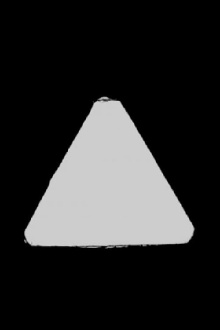
One of my first 16mm films, made without a camera as an experiment in how to visualize rhythm. It equates four simple shapes with four simple sounds, made by punching shapes into black film and scratching into the film's optical sound track. The film uses a bar structure similar to a music score. Each bar lasts one second (24 frames of film) and is divided into 2, 3, 4 or 6 aural and visual beats per second (bps). These are used in alternating patterns such as:
2/3, 3/4, 3/4/6, 2/3/6 In each section of the film an arbitrary relationship is established between image, sound and beats per second, for example:
circle = 12 scratches per frame (high pitch sound) at 6 bps
rhombus = 6 scratches per frame (mid pitch sound) at 4 bps
triangle = 3 scratches per frame (low pitch sound) at 3 bps
rectangle = 1 scratch per frame (percussive sound) at 6 bps A print of the film was hand-painted in 2006 G.S.
Originally edited in two versions. Version I, 70 minutes; version II, 90 minutes. (The only known existing version is not Markopoulos’s edit and contains additional titles, music and voice-over added later than 1961.
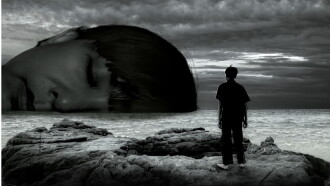
Two fragments of 8mm home-movie footage shot by the artist near Berlin weave together in repeating cycles of action, temporal manipulation, and colour distortion, heightening the viewer’s awareness of film-time and the film-image, and perception of colour in motion.
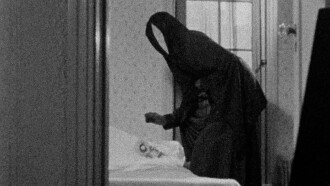
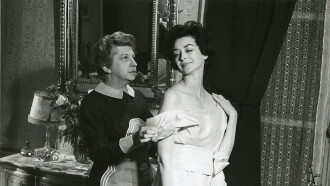
An experimental movie based on a poem of the French writer and director Jean Cocteau about a servant who fantasises about killing the lady of the house.
An observational film that using the fragmented format of a newscast program proposes a cinematic glance to the same reality depicted daily by the media.
Dark blood red slow shifting tones (often embedded in dark) / (often shot-thru with parallel wave-like lines) composed of all previous shapes and flowers as if trying, linearly, to evolve a glyph-script.
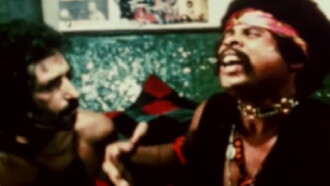
The quasi-fictional story of transgender sex workers living in Rio de Janeiro's swampy red light district, who are joined by a group of hippies and a runaway stockbroker, "Mangue-Bangue" is the paradigmatic expression of the post-1968 spirit of desbunde, the Brazilian slang catchword for "sex, drugs, and rock 'n' roll".
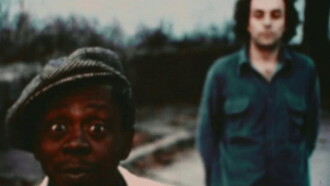
The rare short film presents a curious dialogue between filmmaker Julio Bressane and actor Grande Otelo, where, in a mixture of decorated and improvised text, we discover a little manifesto to the Brazilian experimental cinema.
Alternative movies trailers for Sound Shapes
More movie trailers, teasers, and clips from Sound Shapes:
Sound Shapes #1 | W/ Chest
Intro Song: Underswap - Passive Megalovania.
Popular movie trailers from 1972
These some of the most viewed trailers for movies released in 1972:
“It’s not how it used to be.” The words of Cézar Néwashish resonate throughout this short documentary that explores the history of the Atikamekw community of Manawan, Quebec.
This Spanish-Italian co-production tells the story of a man who feels deep guilt for the death of his wife: he, an alcoholic, is convinced that he accidentally caused her fatal fall in their house while he was drunk.
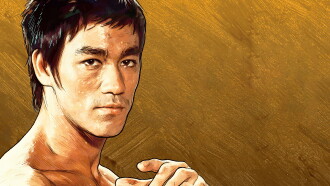
After a Chinese restaurant in Rome is threatened by the mafia, who will stop at nothing to acquire the property, the owner recruits a family friend in Hong Kong, kung fu expert Tang Lung, to help them defend their business.